

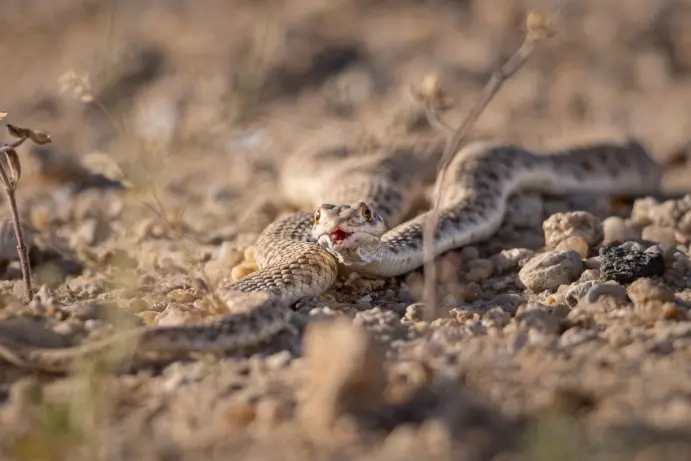
Environmental activist Dr. Abdullah Al-Zaidan successfully documented the presence of the mole snake in the desert environment, shedding light on one of the region’s most intriguing reptiles, commonly referred to as the “false cobra” due to its unique defensive behavior and striking appearance in arid habitats.
Al-Zaidan explained that this snake is classified as a medium-sized species, featuring a slender body and a length ranging from 80 to 190 centimeters, along with a sandy or light brown coloration that provides effective camouflage in desert landscapes, making it difficult to detect.
He noted that the snake is locally known as “Abu Al-Oyoun,” and when threatened, it expands its neck area to mimic the hood of a real cobra, a defensive tactic designed to intimidate predators despite being significantly less dangerous than true cobras.
The species is widely distributed across North Africa and the Middle East, with local presence in multiple desert regions including Sabah Al-Ahmad Reserve, Al-Julaia, northern areas such as Al-Salmi, and southern wilderness zones, where it adapts to harsh climates and remains active during daylight hours.
Al-Zaidan emphasized that the mole snake plays a vital ecological role by feeding on lizards, rodents, and small birds, helping regulate their populations, while also serving as prey for larger predators, thereby maintaining balance within the food chain and supporting biodiversity and ecosystem stability in desert environments.





Comments
Log in to write a comment