

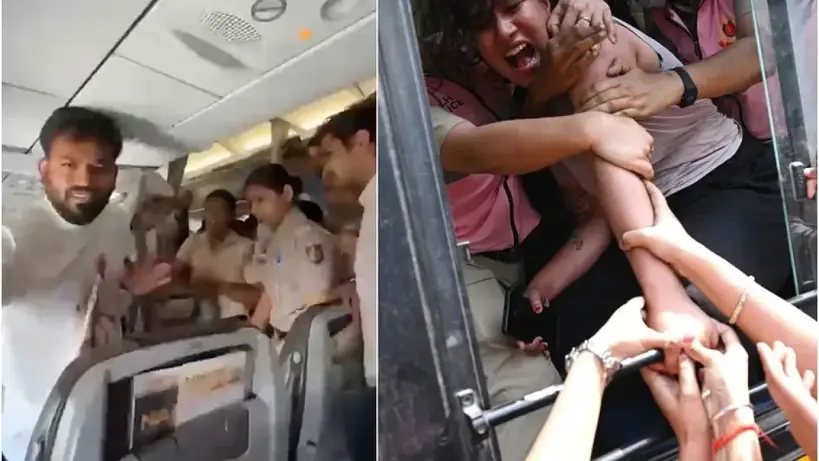
Indian police detained scores of protesters, political figures and activists on Saturday as authorities imposed extensive security restrictions across New Delhi to prevent a youth-led rally demanding the resignation of Chief Election Commissioner Gyanesh Kumar.
The demonstration was organised by the Cockroach Janta Party (CJP), also referred to as the Cockroach youth movement. It was planned for 10 a.m. at Jantar Mantar, an area designated by authorities for protests in central New Delhi. Organisers said the event, described as an effort to “Save Democracy”, was intended to challenge a voter-list revision that critics allege benefits Prime Minister Narendra Modi’s Bharatiya Janata Party (BJP).
Reuters witnesses reported that some young demonstrators in central Delhi shouted, “Long live the revolution,” as police pursued protesters and took others away in buses. Yogendra Solanki, who was being put onto a bus, told Reuters: “This is violating the rights of the people and the country will not tolerate this anymore.”
CJP leaders and other figures detained
CJP said its founder, Abhijeet Dipke, along with senior leaders Saurav Das and Ashutosh Ranka, was detained when the aircraft carrying them from Mumbai arrived in Delhi. The group condemned what it called the “authoritarian detention” of its leaders, describing it as a “pre-planned interception” designed to weaken the rally’s leadership, and called for their immediate release.
Television footage showed Dipke telling officers who spoke to the three men aboard the aircraft: “I have come to be arrested, arrest me... I am not afraid of you guys.” An officer replied: “No, this is not an arrest. Please cooperate.”
Before travelling to Delhi, Dipke had criticised the security measures. Speaking to ANI in Mumbai, he asked why the prime minister was “so scared of the country’s youth, the country’s people?” He also questioned the closure of railways, metro services, internet access and roads, calling the restrictions “nothing but fear”.
Indian media, citing police sources, reported that YouTuber Dhruv Rathee was detained on Saturday morning at his home in Gurugram’s Sector 56. Rathee was in the National Capital Region to take part in the planned protest. According to those reports, about 50 Delhi Police personnel arrived at his residence before detaining him.
The Communist Party of India (Marxist) said Delhi Police also detained Rajya Sabha MP John Brittas, former Kerala chief minister Pinarayi Vijayan and former state minister K N Balagopal. Brittas said they were initially taken to Chhatrasal Stadium before being moved to another location.
Representatives of two digital media outlets said in posts on X that four of their reporters were detained while covering the protest. The president of the Supreme Court bar association also said in a post on X that lawyers protesting outside the court had been taken into custody. Police did not immediately comment on the reported detentions.
Transport and communications restrictions
Authorities deployed thousands of security personnel across the city, which has a population of about 20 million. Reuters witnesses said 45 metro stations and markets were closed, while mobile internet services were suspended in the central business district.
Police stopped buses at entry points to search for protesters and checked cars and other vehicles entering the capital, according to Reuters. Barricades and concrete blocks restricted traffic on major routes, where anti-riot vehicles equipped with tear-gas guns were also positioned.
The restrictions delayed protesters seeking to reach Jantar Mantar. On Friday, Delhi Police said it had not granted permission for the rally and warned that anyone violating the order would face legal action. CJP nevertheless said it would proceed, citing what it described as the exercise of a fundamental right.
Dispute over voter-list revision
The rally followed a series of demonstrations that began last week after the Indian Express reported that Kumar’s deputies had questioned and disagreed with him over voter-list revisions that removed about 130 million entries. Opposition parties have long accused the government of seeking to shape voter rolls to its advantage, and renewed those accusations after the report.
Protesters allege that the BJP, working with its appointees at the Election Commission including Kumar, used the revision process to influence election outcomes. Opposition parties say the deletions affected results in some recent state elections won by the BJP and have raised concerns about electoral processes in India.
Kumar has not commented on the allegations. The Election Commission and the BJP have denied them. The BJP says Modi’s popularity and India’s economic growth explain its electoral success, and accuses opposition parties of misleading the public because they have been unable to win elections.
Election Commission figures show that about 130 million names were deleted during the verification exercise. The total includes 63 million people recorded as having relocated, 30 million who could not be traced and 28 million who were listed as dead. The commission says these were entries flagged during the draft revision process, and that voters removed in error can register again.
The demonstrations present a political challenge for Modi months before a series of major state elections due to begin in early 2027. They follow protests over examination paper leaks that led to the resignation of his education minister several months ago.
Comments
Log in to write a comment