

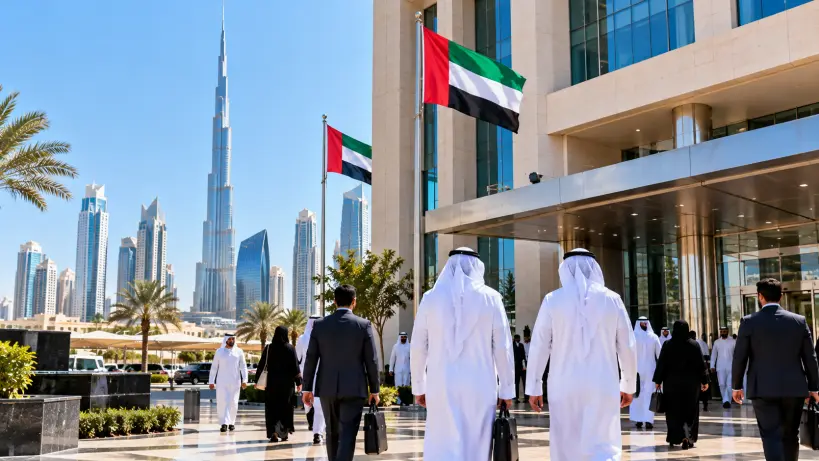
The United Arab Emirates has revealed significant developments in its labour market, with the Ministry of Human Resources and Emiratisation reporting that the private-sector workforce grew by more than 101 percent over the past five years. The number of companies operating in the sector also increased by approximately 46 percent during the same period, highlighting the substantial expansion of employment and business activity across the country.
The figures were presented as part of the UAE’s participation in the second Doha Dialogue on labour mobility between Africa and the Gulf Cooperation Council countries, hosted in Dar es Salaam, Tanzania, on October 5 and 6, 2026. The Emirates News Agency published details of the UAE’s participation on Friday, October 9, with representatives from 34 Gulf, African and Arab countries attending alongside regional and international organisations.
Held under the theme of advancing fair and sustainable labour mobility between Africa and GCC states, the dialogue provided a platform for labour-sending and labour-receiving countries to exchange experiences, discuss shared challenges, and explore practical approaches to improving the governance of international employment and migration.
During the meetings, the UAE highlighted its integrated approach to labour mobility, which focuses on strengthening worker protections, developing professional skills, and using advanced technology and artificial intelligence to support decent employment. The approach also emphasises international cooperation as an important component of sustainable and well-regulated labour movement.
The ministry reported that the UAE’s private-sector workforce had expanded by more than 101 percent over five years, while the number of companies increased by around 46 percent. These figures reflect cumulative growth across the period and should not be interpreted as wage increases, a single-year employment growth rate, or a new total of work permits issued under a recently introduced programme.
Looking ahead, the UAE is placing greater emphasis on identifying the skills and occupations that will be needed in the future rather than responding only to current employment requirements. The ministry highlighted the UAE Skills Platform, an artificial intelligence-supported initiative intended to anticipate emerging occupations and skill requirements while helping align education and training programmes with labour market demand.
The UAE also stressed the importance of stronger cooperation between countries of origin and destination for international workers. Such cooperation can support more organised recruitment systems, improved professional development, better protection of worker rights, and practical solutions to challenges associated with cross-border employment and workforce mobility.
The Doha Dialogue complements established regional cooperation initiatives, including the Abu Dhabi Dialogue, launched by the UAE in 2008. That earlier platform brought together Asian labour-sending countries and Gulf labour-receiving states to promote consultation, exchange expertise, and improve the governance of contractual labour mobility between participating countries.
For expatriate residents and international jobseekers, it is important to distinguish between the policies discussed during the dialogue and binding changes to immigration or employment regulations. The official announcement did not introduce a new work visa category, announce changes to work permit fees, remove residency requirements, or authorise unrestricted transfers between employers or countries.
The UAE’s participation reflects its broader commitment to developing a competitive and sustainable labour market supported by technology, skills development, international cooperation, and worker protection. Further practical developments will depend on future programmes, formal agreements and regulatory announcements issued by the relevant authorities.





Comments
Log in to write a comment