


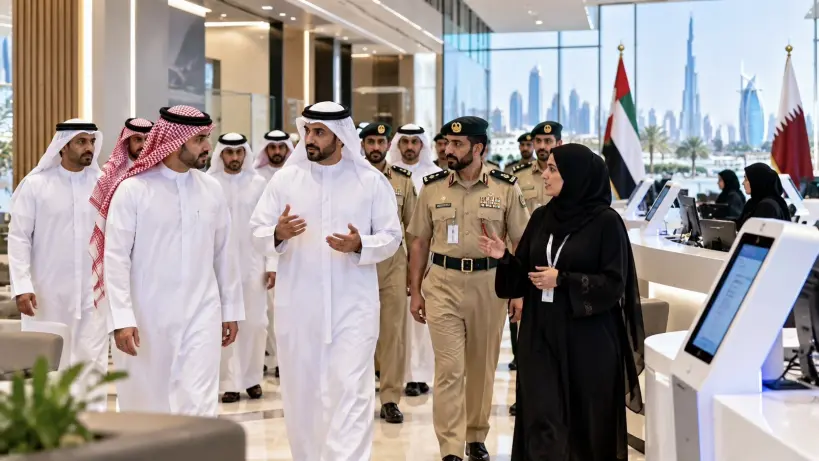
The United Arab Emirates has reported new developments in government cooperation concerning entry permits and residency services, following an official visit by a delegation from Qatar’s Ministry of Interior to Dubai’s General Directorate of Identity and Foreigners Affairs. The visit focused on examining Dubai’s experience in modernising immigration-related services, simplifying administrative procedures and using advanced technologies to improve the efficiency of government transactions.
According to a report published by the Emirates News Agency on Friday, October 9, 2026, the Qatari delegation visited Dubai as part of efforts to strengthen cooperation and exchange government expertise between the two countries. The visiting officials met Lieutenant General Mohammed Ahmed Al Marri, Director General of the General Directorate of Identity and Foreigners Affairs in Dubai, alongside senior officials responsible for residency and entry permit services.
The Qatari delegation was led by Brigadier Mohammed Ali Al Muhannadi, Director of the Unified Services Department at Qatar’s General Directorate of Passports. Senior Dubai officials participating in the meetings included Major General Obaid Muhair bin Suroor, Deputy Director General, and Major General Khalaf Ahmed Al Ghaith, Assistant Director General for the Entry Permits and Residency Sector.
During the visit, Dubai’s immigration authorities presented their integrated system for managing entry permits and residency services. The presentation covered administrative procedures, ongoing development projects and efforts to improve the customer journey from the initial application stage through the completion of relevant transactions. Officials also discussed better coordination between government entities and ways to reduce unnecessary procedural complexity.
A major focus of the visit was the use of artificial intelligence-supported automated approvals, alongside integrated service packages designed to simplify transactions involving multiple administrative steps. These digital solutions form part of Dubai’s broader approach to improving the speed, consistency and efficiency of government processes while maintaining the necessary regulatory and operational requirements.
The delegation also reviewed digital monitoring and auditing systems used for Amer service centres, which provide a range of immigration-related services in Dubai. Additional presentations covered performance dashboards that help government officials evaluate operational results and make data-informed decisions, as well as programmes aimed at reducing bureaucracy and applying behavioural insights to service design.
Lieutenant General Mohammed Ahmed Al Marri emphasised that developing entry permit and residency services remains a central part of Dubai’s commitment to delivering more efficient and flexible government services. He highlighted the importance of simplified procedures, integrated service delivery and advanced technological tools in supporting Dubai’s vision for proactive, people-centred public administration.
Al Marri also explained that excellence in government services requires more than technology alone. Effective governance, skilled personnel, innovation and continuous improvement are equally important components of a successful service system. He welcomed the Qatari delegation’s visit as an opportunity to deepen knowledge-sharing and strengthen institutional cooperation between the two countries.
The programme included a tour of Dubai’s Innovation and Future Centre, where the visitors examined innovative projects and initiatives. The delegation also explored the Customer Experience Laboratory and the Innovation Accelerators Laboratory, gaining insight into the methods used to improve public services and anticipate future customer requirements.
These developments are relevant to expatriate residents, businesses and other individuals who regularly use immigration and residency services in Dubai. Continued investment in digital systems may support more convenient transactions and improved government service delivery over time, although the visit itself was primarily concerned with institutional cooperation and the exchange of technical expertise.
Importantly, the official announcement did not introduce a new visa category, change residence permit fees, alter entry requirements or establish additional exemptions for expatriates. Any future regulatory changes would require separate announcements from the relevant UAE authorities, and residents should continue following existing official immigration rules and procedures.
The visit highlights the growing exchange of technological expertise between the UAE and Qatar, particularly in the fields of digital government, artificial intelligence and administrative efficiency. Both countries continue exploring ways to modernise public services and share successful practices that may contribute to better institutional performance and more accessible government transactions.





Comments
Log in to write a comment