


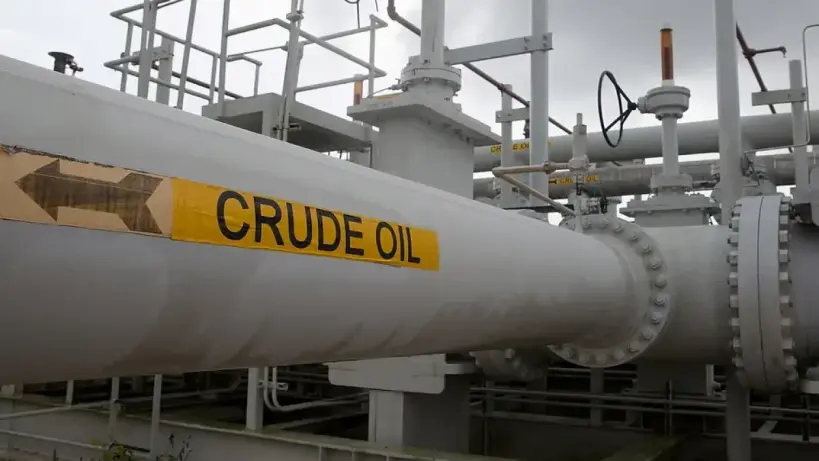
Oil prices were broadly stable on Tuesday, with Brent trading near $100 a barrel, as increased crude shipments from the Middle East and a planned Group of Seven emergency stock release were weighed against the risk of further supply disruptions linked to Houthi attacks in Yemen.
At 12:33 p.m. EDT (1633 GMT), Brent crude futures were down 29 cents, or 0.3%, at $100.03 a barrel. US West Texas Intermediate crude was up 16 cents, or 0.2%, at $89.59 a barrel. Brent was on course for its lowest settlement since September 22.
John Evans, an analyst at oil broker PVM, said the case for Brent to remain well above the $100 level had weakened as assumptions of increased crude flows reduced market pressure. “The price of the global crude benchmark, Brent, is once again toiling around $100/barrel, as its reasons for trading much beyond the psychological 3-digit mark are being eroded ... for now the assumption of more crude getting through has dampened price fervour,” he said.
The chief executive of commodity trader Vitol said about 12 million barrels per day of crude oil and 2 million bpd of refined products had left the Middle East aboard tankers over the previous seven to 10 days. Those volumes were needed to help ease price pressure, the executive said.
Saudi Energy Minister Prince Abdulaziz bin Salman said oil transported through the East-West Pipeline to Yanbu, Saudi Arabia’s Red Sea export hub, had reached 5.8 million barrels by Tuesday morning.
Supply risks remain in focus
Despite the pressure from higher export volumes, concerns over potential disruption to Middle East supplies limited losses in oil prices.
Saudi Arabia’s aviation authority said airports in Jazan and Najran were targeted in two attacks on Monday evening. Three people were injured and the damage was limited, according to the authority.
The incidents came as Saudi-backed Yemeni government forces pursued a major offensive to regain territory from the Iran-backed Houthi movement following weeks of rebel advances. Riyadh had increased airstrikes in support of the campaign. Separately, the Saudi-led coalition said it intercepted and destroyed a ballistic missile launched by the Houthis.
G7 release and diesel shortages
The International Energy Agency is due to meet next week to determine the details of a diesel stock release, sources said. The meeting follows uncertainty in the market over the amount of crude, diesel and other products that Europe and the United States intend to release to address shortages and record-high prices.
Diesel costs have become a global economic and political concern because the fuel is used across trucking, agriculture and industry. The source material said wars in Iran and Ukraine had cut exports and damaged refineries, contributing to the rise in prices.
Under pressure from US President Donald Trump, the G7 agreed on Friday to release 100 million barrels of diesel and crude from emergency reserves. The group also pledged not to impose energy export restrictions. It did not specify the quantities of crude, diesel or other products involved, nor did it identify which countries would take part.
The US Energy Information Administration projected on Tuesday that global petroleum production would fall from a record 106.3 million bpd in 2025 to 101.1 million bpd in 2026, while global oil demand would decline from a record 104.4 million bpd to 102.4 million bpd over the same period. The EIA linked the supply outlook to the disruption of Middle East oil flows caused by the war in Iran.
For 2027, the EIA forecast that world production would rise to a record 109.6 million bpd and consumption would reach a record 104.6 million bpd.
In the United States, traders were awaiting weekly storage data from the American Petroleum Institute on Tuesday and the EIA on Wednesday. Analysts expected US energy companies to have added 1.8 million barrels of crude to inventories in the week ended October 2.
If that estimate proves correct, it would be the first three-week run of rising US crude inventories since August. It would compare with a 3.7 million-barrel build in the equivalent week a year earlier and a five-year average increase of 1.7 million barrels for 2021 through 2025.




Comments
Log in to write a comment