


Saudi Arabia has announced the approaching final phase of mandatory compliance with its licensed collective worker housing requirements. The measure is particularly relevant to business owners, employers and expatriate workers covered by the accommodation framework. Its purpose is to improve living conditions, strengthen health and safety standards and reduce the use of unsuitable buildings for collective accommodation.
Saudi Arabia Requires Licensed Group Housing for Establishments With Fewer Than 250 Covered Workers From February 2027
Saudi Arabia
Font
Article text size
English fonts
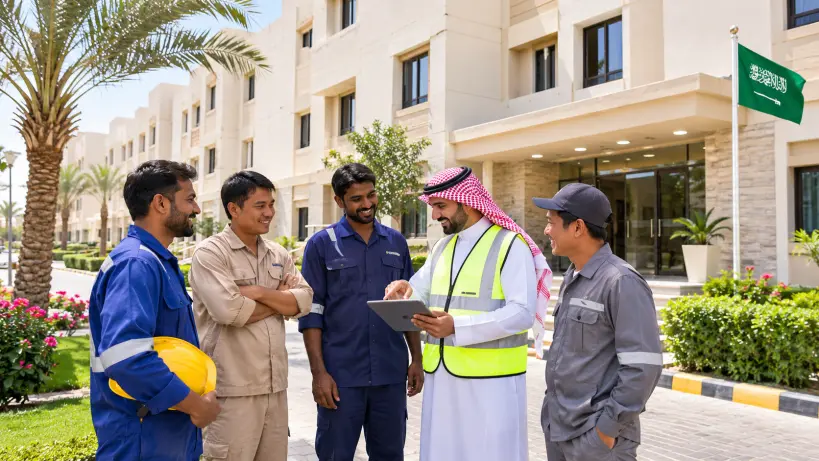
Workers in Saudi Arabia
The announcement was issued on Thursday, October 29, 2026, by the National Program for Developing Group Housing for Individuals, which is chaired by the Saudi Ministry of Municipalities and Housing. The program confirmed that establishments with fewer than 250 workers falling within the targeted category must regularize their accommodation arrangements before the final compliance phase begins on February 1, 2027.
According to the official statement, the remaining period represents an opportunity for affected establishments to complete their preparations and correct any outstanding compliance issues. The program encouraged employers to take action before the deadline to avoid potential regulatory measures under the applicable laws and guidelines.
The first of two approved compliance pathways allows an establishment to obtain a collective housing license for accommodation associated with its own operations. The relevant property must meet the applicable technical, health and safety standards before a license can be issued through the authorized procedures and platforms.
The second pathway allows an establishment to enter into an agreement with an accommodation provider operating already licensed collective housing units. This provides an alternative for employers that do not wish to own or manage dedicated accommodation buildings, while still requiring them to meet the relevant contractual and regulatory requirements.
Saudi Arabia’s Balady platform provides electronic services related to collective housing licenses, while designated authorities handle certain licensing arrangements within industrial cities. Accommodation must satisfy the appropriate building, safety and occupancy requirements, including the relationship between the facility’s licensed capacity and the number of covered workers.
The reference to establishments with fewer than 250 targeted workers concerns the final phase of implementation and should not be interpreted as automatically including every employer regardless of the type and number of workers involved. Earlier Ministry guidance explained that the broader collective housing framework applied to covered establishments with at least 20 workers.
It is also important to distinguish the latest announcement from the original introduction of the housing compliance framework. The Ministry previously stated that mandatory implementation began gradually in September 2025, with larger establishments addressed before medium-sized and smaller businesses. The October 2026 announcement confirms the timing of the final phase rather than creating the entire housing system from scratch.
Earlier government guidance also described electronic integration between the Balady and Qiwa platforms to support compliance verification. This arrangement allows the authorities to examine licensed accommodation capacity alongside the number of workers associated with an establishment and to identify situations requiring regulatory attention.
The Ministry has previously warned that noncompliance may affect access to certain government services under the relevant procedures. However, the October 29 announcement did not specify a single fixed monetary fine applicable to every establishment failing to complete the accommodation requirements before February 2027.
Consequently, employers should not assume that an unspecified financial penalty has been officially established by the latest statement. Any potential consequences should be checked against the applicable regulations, inspection guidelines and the specific circumstances of the establishment concerned.
The policy is particularly relevant to companies employing expatriate workers in sectors where collective accommodation is common. Licensed housing is intended to improve living standards, help reduce overcrowding and ensure that facilities comply with essential requirements related to sanitation, technical suitability and safety.
Affected employers are advised to review the current status of their accommodation facilities, confirm the validity of relevant licenses and agreements, and verify that authorized occupancy limits are appropriate for the number of workers housed. Where accommodation is not licensed, they should pursue an approved licensing process or arrange accommodation through an authorized provider.
The National Program for Developing Group Housing for Individuals involves cooperation between the Ministry of Municipalities and Housing and other government authorities responsible for regulation, public health, employment and safety. The initiative forms part of continuing efforts to improve accommodation standards and compliance across Saudi cities.
The final implementation phase is scheduled to begin on February 1, 2027. Establishments within its scope should therefore use the remaining corrective period to complete the necessary arrangements and consult the Ministry’s official guidance and Balady services before the requirements become applicable to them.
Source: Saudi Ministry of Municipalities and Housing – National Program for Developing Group Housing for Individuals – Saudi Press Agency
What do you think of this story?
Share your reaction, or help us correct a detail.






Thank you for being part of our community. Read our Comment Policy before posting.
Comments
Loading the conversation…