


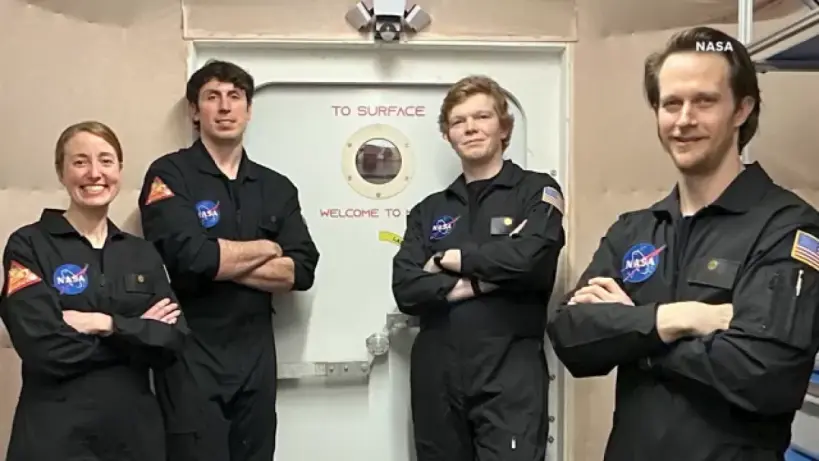
Four volunteers are due to leave NASA's Mars habitat simulator at Johnson Space Center on Saturday, ending a mission that kept them inside for nearly 380 days without sunlight, shopping trips or face-to-face contact with their families.
The participants are the crew of NASA's second Crew Health and Performance Exploration Analog, or CHAPEA, mission. Their yearlong stay took place in a simulator inside a hangar at Johnson Space Center and was intended to examine how people cope with the isolation, distance and difficult conditions expected during deep-space travel.
The crew could not take part in live interviews because of the restrictions of the simulation. NASA instead released a podcast in which members described their experiences as the mission approached its conclusion.
“You can kind of see the finish line coming,” crew member Matthew Montgomery said.
Ross Elder compared the assignment to a demanding outdoor expedition. “I like to call it extreme camping,” Elder said. “Imagine plopping yourself down in a very remote location with nothing but the items on your back.”
Testing daily life in a confined mission
During the simulation, the volunteers carried out experiments, tested technology and completed simulated spacewalks. Their work also included practical tasks required for an isolated crew, such as cutting their own hair, dealing with plumbing problems and conducting health checks.
Ellen Ellis said the crew trained to perform medical procedures that would ordinarily require outside support. “Routinely, we perform self-blood draw,” she said. “We do the blood draw ourselves and a supporting crew member if they need to assist if necessary. We also got practice with an ultrasound probe.”
John DeWitt, Rice University's director of sports science and a former NASA scientist, said the project is meant to assess how research volunteers manage three conditions that will be particularly important in deep-space flight: isolation, distance and a hostile environment.
“I think that's what a lot of the project is going to try and find out is how are the astronauts, or in this case research volunteers, dealing with three hazards that are going to be very important for deep space flight,” DeWitt said.
The crew also maintained a substantial exercise routine. DeWitt said supplying enough food for physically active crews is another issue that must be addressed before people are sent into space. “That's a really big problem that they have to tackle and be ahead of before we actually send people to space,” he said.
Looking ahead to life outside the habitat
As Saturday's exit approaches, crew members said they are anticipating ordinary experiences that were unavailable during the mission. Elder said he missed “the sound of weather, busy streets, and just commotion in general.”
Ellis said she was especially looking forward to “seeing my husband smile at me when the egress door opens.”
The mission is the second long-duration simulation of this type conducted by NASA. The agency is accepting applications for its next yearlong simulated Moon and Mars mission, an opportunity officials say may help prospective astronauts begin pursuing that path.





Thank you for being part of our community. Read our Comment Policy before posting.
Comments
Loading the conversation…