



Artificial intelligence could create more than $1 trillion (Dh3.67 trillion) in economic and sustainability value across the Middle East and North Africa by 2030, according to two World Economic Forum reports. The studies say the opportunity will depend on whether the region can expand data-centre capacity while meeting growing demands for electricity and water.
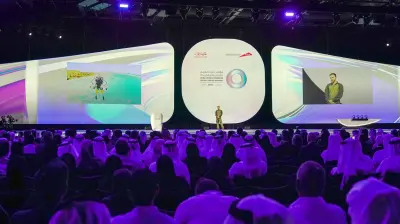
The reports were published on Wednesday during the inaugural Annual Meeting of Global Future Leaders 2026 in Dubai, held from October 13 to 15. More than 400 leaders and experts are taking part in the gathering, whose insights will feed into the World Economic Forum’s work during the year and its Annual Meeting 2027 in Davos-Klosters, the WEF said.
One report, Unlocking Value: AI for Resilient Growth in MENA, was prepared with Bain & Company. The other, Optimising Hyperscale Data Centre Infrastructure in Mena, was developed with Saudi Research and Media Group (SRMG). Together, they examine how the region could translate AI ambitions into sustainable value while establishing the energy, water and digital infrastructure required for large-scale growth.
“Mena has the resources, investment capacity and ambition to become a major centre of AI-led growth. Turning that ambition into reality will require innovation across data-centre infrastructure, energy and water systems, and the application of AI to drive sustainability solutions,” said Maroun Kairouz, managing director at the WEF.
Potential value across five areas
Bain & Company’s assessment divides the potential value into five categories. It estimates that the financial sector could enable up to $200 billion in sustainable financing, while public-sector action could support $370 billion in sustainable investment flows.
The report also identifies $250 billion in long-term asset losses that could be avoided, $90 billion in additional energy-sector valuation through improved sustainability performance, and $100 billion in sustainable projects launched through partnerships across sectors.
Christophe De Vusser, worldwide managing partner at Bain & Company, said AI brings a distinct combination of opportunities and challenges in every region, including questions around economic growth and innovation, energy supply and cost, and risk management.
“This report uniquely covers how that mix sits in Mena, with disproportionate focus on resilience, while leveraging its unique energy and geopolitical position as a boundary region,” he said.
Adoption remains below perceived potential
The Bain & Company report points to a gap between expectations for AI and its practical use. Among sustainability leaders surveyed through the Mena Chief Sustainability Officers Network, 89 per cent said AI had high or very high potential to help their organisations meet sustainability objectives.
However, only 40 per cent to 55 per cent said their use of sustainable AI applications was at either the piloting or scaled stage, with the figure varying by use case.
The SRMG-backed report argues that AI infrastructure must be approached as an interconnected systems issue, rather than a technology challenge alone. It says gigawatt-scale deployment requires coordinated planning and operations across digital networks, power supplies and water infrastructure.
According to the report, Mena may be able to connect new data centres to power grids in two to five years, compared with more than a decade in mature markets. It says this could give the region a competitive advantage in the expansion of AI infrastructure.
“Mena is uniquely positioned to lead the next wave of digital infrastructure by bringing together its energy capabilities, investment capacity and technological ambition,” said Nedaa Almubarak, managing director of SRMG Think.
“The opportunity lies in aligning intelligent infrastructure with efficient resource use to build resilient, sustainable and competitive digital ecosystems that drive long-term economic growth and innovation.”
Power and water pressures
The reports also caution that the region’s infrastructure advantage could weaken if the increase in energy and water consumption is not managed effectively. Globally, cooling can account for more than 40 per cent of a data centre’s total electricity use, and extreme temperatures across much of Mena make efficient cooling particularly energy-intensive.
AI workloads may also produce sudden and unpredictable surges in demand. The report warns that data centres need to accommodate those volatile loads without disrupting electricity grids or water systems.
It recommends smarter data-centre design, AI-supported operations, advanced cooling technologies and updated regulations to help develop a more resilient data-centre ecosystem.
Source: Khaleej Times





Thank you for being part of our community. Read our Comment Policy before posting.
Comments
Loading the conversation…