


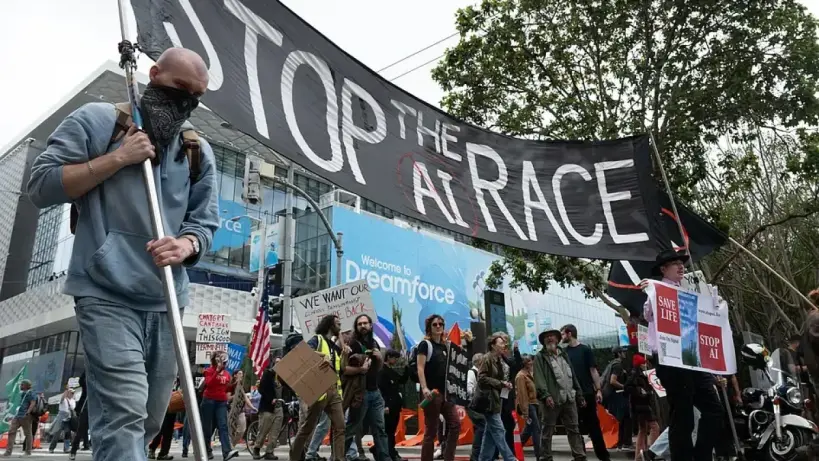
The worldwide push to develop artificial intelligence is unlikely to lose momentum, according to two technology executives who said competition, commercial pressure and rapid advances will continue to drive the sector forward despite calls for leading companies to slow work on the most capable models.
Matt Swalley, senior director for AI and HPC data storage infrastructure at Vdura, said the industry remained focused on speed. “I don’t see it slowing down very much,” he said, describing AI development as “a race to who can develop these things the fastest”.
Shady Khattab, director of AI sales, architecture and solution at open-source software company Suse, expressed a similar view. “I don’t think it will slow the innovation,” he said on the sidelines of the AI Everything exhibition in Abu Dhabi.
The executives’ comments contrast with calls from several prominent figures in the AI sector for greater restraint around frontier systems. OpenAI chief executive Sam Altman reportedly told employees that the company was considering slowing the development of cutting-edge AI and hoped other laboratories would do the same, although he acknowledged that some may not agree.
In an interview with Time, Altman said he believed “it is a good time to slow down” model development. He has also suggested that leading AI laboratories could be close to announcing an agreement to reduce the pace of development while addressing increasing safety risks.
OpenAI chief scientist Jakub Pachocki has called on companies to coordinate any needed slowdowns. More than 1,000 employees at major AI firms signed a petition in July seeking a mechanism to slow development. Anthropic chief executive Dario Amodei has written that frontier AI companies need to reduce the pace, while continuing to lead China. Microsoft co-founder Bill Gates, meanwhile, has said safety measures can be incorporated into current AI systems without slowing overall development.
Governance and sovereignty
Khattab said such appeals should be understood as a push for stronger oversight rather than an attempt to stop innovation. “Control doesn’t mean by default to slow down, but it means to secure and to give the trust to that AI. None of them will stop innovation.”
He said organisations were continuing to invest because they saw AI as a practical tool rather than a passing trend. At the same time, he said, many were building AI applications before establishing the architecture required to govern them, an approach that can undermine pilot projects.
“The problem that we are facing right now is that the AI is evolving so fast, and everyone is looking forward to develop the solution faster than taking the time to architect that solution,” Khattab said.
He described digital sovereignty as resting on three components: compliance with laws and regulations; locality, referring to where data is stored; and freedom or mobility, meaning the ability to move between models or vendors.
For companies in the UAE, local data centres are helping address the locality requirement, Khattab said. Sensitive information should remain in the country, either on a company’s own infrastructure or with a cloud provider based in the UAE, he added.
He also pointed to threats that regional companies face as AI capabilities develop, including identity theft, code breaches, data injection and data deletion.
Storage pressures grow with inference
Swalley said AI companies have shifted their attention from obtaining computing hardware to making their investments commercially sustainable. “Two years ago, the conversation was how can I get GPUs (graphic processing units)? How can I deploy them as fast as possible? Now we’re moving to how do I fund and generate revenue from all this investment,” he said.
As the industry moves beyond training models and towards inference, when trained systems generate responses or carry out tasks, data storage is becoming a central constraint, Swalley said. “Data storage really is that bottleneck.”
He expects inference to make up 90 per cent of AI workloads by 2030. That shift would make inference the main source of revenue for AI cloud operators, whose objective is to keep their graphics processing units in use, he said.
Swalley called the UAE a priority market, citing its resources, energy and expertise, as well as the country’s AI Strategy 2031. “You have the resources, you have energy, you have the expertise,” he said.
Both executives said AI could have wide-ranging practical uses. Khattab cited applications in healthcare, genomics and farming supported by drones. Swalley said businesses can develop tools “in minutes that used to take months and months of production”.






Thank you for being part of our community. Read our Comment Policy before posting.
Comments
Loading the conversation…