


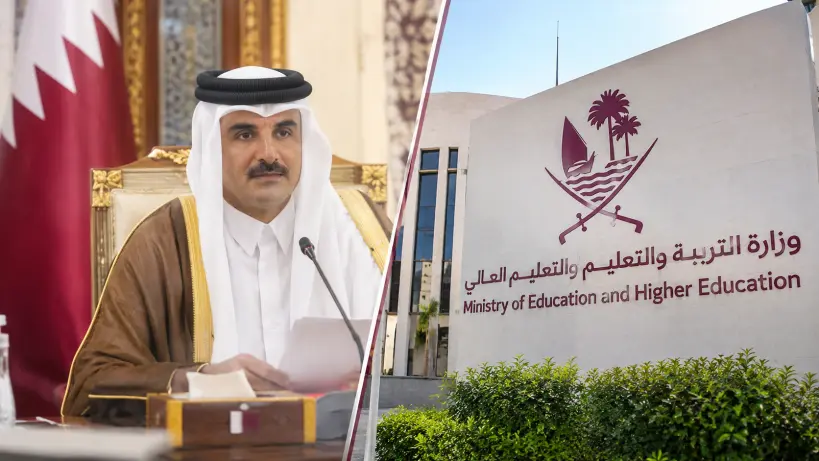
Qatar’s Ministry of Education and Higher Education has officially launched the first edition of its Educational Voucher Policy for private schools and kindergartens, introducing a more comprehensive framework for educational support.
Qatar Announces New Education Voucher Policy for 2026: Support Up to QAR 78,000 and Expanded Eligibility
Qatar
Font
Article text size
English fonts
Qatar Ministry of Education
The announcement was made on Thursday, November 5, 2026, during a press conference attended by ministry officials, representatives of private educational institutions, and members of the local media.
The policy aims to expand educational choices for Qatari families, promote equal opportunities, improve accountability, and reduce the financial burden associated with private education.
It also establishes clearer requirements for participating institutions and additional support arrangements for eligible students with disabilities.
Under the newly announced policy, the maximum educational voucher available to a Qatari student following the regular education pathway is QAR 28,000, subject to the applicable eligibility requirements.
For students with disabilities, the ministry has introduced three approved financial support levels of QAR 43,000, QAR 53,000, and QAR 78,000, depending on the assessed level of educational assistance required.
These amounts cover eligible tuition fees and approved educational or rehabilitation services, with individual assessments and relevant ministry approvals forming part of the process.
The published figures represent educational support limits rather than unconditional cash payments to every family or automatic entitlements for all private school students.
A major development is the inclusion of standalone private kindergartens in the educational voucher framework for the first time, provided they meet the ministry’s approved standards.
Newly established private schools may also qualify for educational vouchers from the beginning of their operations, subject to the applicable regulatory and quality requirements.
The approval criteria consider educational performance, modern facilities, tuition fees, student capacity, national investment partnerships, staff development, and services supporting community needs.
Applications from standalone private kindergartens will open on April 1, 2027, with results expected by the end of June 2027 for participation during the 2027–2028 academic year.
The ministry also clarified eligibility arrangements for students repeating an academic year, including those seeking to improve their academic averages in Grades 11 and 12.
Additional provisions address students transferring between different educational curricula and the continued eligibility of children whose parents or guardians enter retirement.
For students with disabilities, participating institutions must obtain approval for individual education plans, complete the required assessments, and secure approval for applicable tuition fees.
These procedures are intended to ensure that additional financial support corresponds to assessed educational needs and approved services.
The disability support framework will be introduced in two phases, beginning with students with autism spectrum disorder and certain intellectual, hearing, visual, physical, and multiple disabilities.
The second phase will cover specific learning difficulties, attention deficit hyperactivity disorder, speech and language disorders, and borderline intellectual functioning.
The ministry confirmed that educational voucher invoices will be processed through the National Student Information System, with 50 percent invoiced in October and the remaining 50 percent in February.
Officials also demonstrated electronic application procedures through the Maaref public services portal, including the processing of applications for eligible students with disabilities.
Importantly, this educational voucher policy concerns eligible Qatari students enrolled in participating institutions and does not automatically extend the same financial assistance to all non-Qatari resident students.
Parents and guardians should consult the Ministry of Education and Higher Education for approved schools, eligibility requirements, required documentation, and the applicable application timetable before making enrollment or payment decisions.
Source: Qatar Ministry of Education and Higher Education – Qatar News Agency (QNA) – The Peninsula newspaper.
What do you think of this story?
Share your reaction, or help us correct a detail.





Thank you for being part of our community. Read our Comment Policy before posting.
Comments
Loading the conversation…