


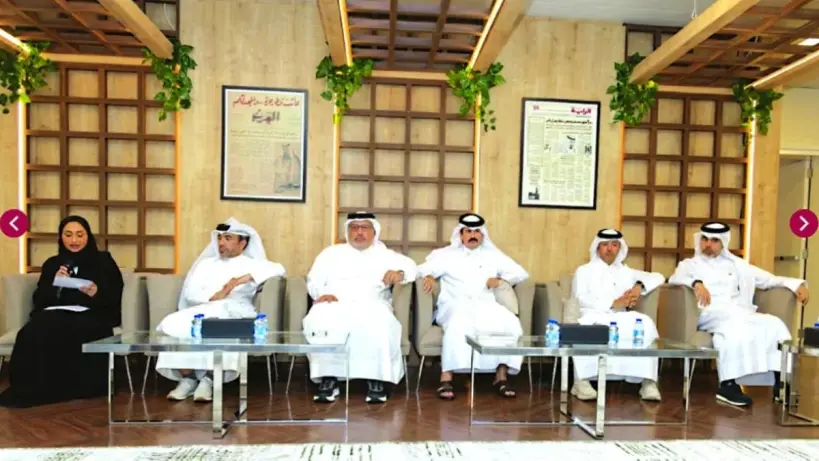
Qatar’s media institutions have been urged to work more closely with security agencies to counter disinformation, address emerging information threats and support national security during a panel organised by the Qatar Press Centre in partnership with the Joaan bin Jassim Academy for Defence Studies.
The discussion involved participants in the seventh National Defence Course at the National Defence College, alongside editors-in-chief of local newspapers and representatives from government and security bodies. It focused on the effects of artificial intelligence, digital transformation and information warfare on the media landscape.
Faisal al-Mudahka, editor-in-chief of Gulf Times, described the challenge as a “war of narratives”. He said Qatar had been subjected to repeated smear campaigns in recent years, with similar methods being used even as circumstances changed.
Al-Mudahka also referred to the expanding use of AI in media activity during regional conflicts. He cited cases in which Iranian-affiliated entities allegedly used the technology to advance their narratives and target Gulf states.
On the changing business of journalism, he said newspapers’ ability to complete their digital transformation was influenced by ownership arrangements and the resources available to them. Many publications, he noted, were founded before websites became part of the media environment.
Qatar Press Centre vice-chairman Jaber al-Harmi said media organisations play an important role in defending the country’s interests and responding to misleading narratives. “The media has always served as a primary and significant line of defence,” he said.
Al-Harmi said the sector had a responsibility to present an accurate picture of Qatar and its achievements while rebutting false claims and disinformation. He added that links between media institutions and state bodies should be sustained in ordinary circumstances, rather than developed only in response to crises.
Faleh Hussein al-Hajri, editor-in-chief of Al-Arab, said recent events had shown the value of a strong media sector when Qatar is targeted by campaigns. He said traditional outlets could retain their role alongside newer platforms if they adjusted to changing conditions without compromising credibility or content quality.
Mohammed Haji, editor-in-chief of Al-Watan, called for a clearer assessment of social-media influence, arguing that a large audience does not automatically mean an account can meaningfully address public concerns or analyse regional developments. He advocated preparing a generation of responsible influencers able to engage with issues affecting society.
Proposals on monitoring and media expertise
Awad al-Ahbabi, an adviser to the Ministry of Foreign Affairs and former deputy ambassador to Venezuela and Albania, proposed creating a specialised group of qualified media commentators. Such commentators, he said, should be able to discuss current affairs on television with strong knowledge of their subjects and cultural awareness. He also warned against overreliance on AI.
Eng. Hamad Jassim al-Bahar of the Ministry of Municipality proposed an integrated smart media-monitoring platform called Al-Hudhud, or The Hoopoe. Under the proposal, the system would monitor news, analyse developing trends, identify publishing sources and evaluate the possible impact of content concerning Qatar, helping relevant authorities respond more effectively to rumours.
Al-Bahar also pointed to influencers and content creators as potential sources of soft power. He suggested creating professional and legal frameworks to support their work.
Sadiq Mohammed al-Ammari, general manager of the Qatar Press Centre, said the centre had operated since mid-2023 in support of newspapers, media professionals and content creators. Its training programmes address information verification, professional reporting and efforts to counter disinformation, he said.
Al-Ammari said the centre also aims to help develop journalists with skills across several formats, including writing, filming and editing material for different platforms.
Participants called for stronger co-ordination between civilian media organisations and military and security institutions. Brigadier-General Khamis Mohammed al-Muraikhi, director of Airport Security at the Ministry of Interior, proposed a joint committee to identify needs and prepare a co-ordinated media strategy.
Other speakers stressed the importance of protecting media sovereignty from AI-generated misinformation, communicating official statistics clearly and balancing the public’s right to information with the need to safeguard sensitive security details. The discussion closed with a focus on press freedom and responsibility, with participants noting that media can be a strategic partner in protecting society, while irresponsible reporting can pose risks to national security.

Thank you for being part of our community. Read our Comment Policy before posting.
Comments
Loading the conversation…