


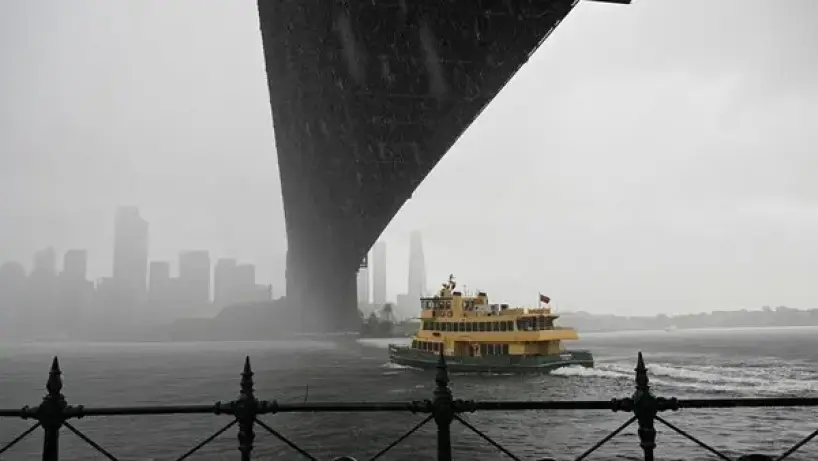
The Bureau of Meteorology (BOM), working alongside the State Emergency Service (SES), officially confirmed the deployment of urgent severe weather notifications targeting millions of residents across New South Wales (NSW) and surrounding territories.
An aggressive meteorological system has rapidly engulfed the nation’s eastern seaboard, generating heavy downpours, gale-force wind vectors, and a sudden, volatile temperature plunge that threatens to compromise residential structural integrity and public safety frameworks throughout the week.
Following the latest updates from official environmental directives, the sheer volume of precipitation scheduled to collapse over the affected metropolitan sectors could easily eclipse standard monthly thresholds in mere days.
Forecasters revealed that several coastal zones have already recorded in excess of 100 mm of rain since Sunday evening, with specialized modeling warning that peak localized accumulations could spike to a dangerous 300 mm, drastically elevating the risk of catastrophic landslips and life-threatening flash floods.
In direct response to this ongoing crisis, emergency responder networks revealed they have handled hundreds of distress calls concerning critical structural damage, uprooted trees blocking major transport arteries, and severe internal inundation within residential complexes.
Simultaneously, destructive winds reaching velocities of up to 100 kilometers per hour have severely compromised local electrical grids, plunging thousands of families into blackout conditions and forcing the comprehensive closure of essential educational centers and public highways.
Furthermore, field technicians from state logistics departments have initiated continuous perimeter monitoring around heavily burdened reservoirs and water catchment zones.
As a result, specific downstream communities are bracing for mandatory evacuation protocols as rising water lines threaten to breach defensive embankments, potentially cutting off regional hubs from essential supply chains and medical networks.
Crucially, civil defense authorities have reiterated a strict warning against any non-essential travel across flooded infrastructure, advising drivers that a significant percentage of recent emergency rescues involved motorists attempting to cross deeply submerged roads.
Public safety experts stress that standard sedans can lose traction and be swept away in as little as fifteen centimeters of moving water, making proactive avoidance the only reliable method to safeguard human life.
Consequently, marine rescue organizations have issued blanket bans on recreational activities along the eastern beaches, citing hazardous surf conditions, rip currents, and massive swell cycles driven by offshore wind vectors.
Residential property owners in low-lying zones are actively encouraged to secure loose outdoor items, clear structural drainage paths, and maintain operational backup power or communication devices to stay updated on real-time alerts.
Looking ahead, climatologists point out that while these torrential bouts offer immediate relief to drought-impacted agricultural sectors, the rapid, high-volume runoff fails to adequately penetrate deep soil columns.
Instead, the sudden combination of intense moisture and freezing Antarctic air masses highlights a broader pattern of climate variability, forcing infrastructure planners to rapidly modernize urban drainage networks to withstand increasingly frequent weather extremes.
Ultimately, community awareness remains the frontline defense against natural disruptions of this magnitude.
By acting on early warnings, respecting barricaded transport paths, and preparing household emergency kits well ahead of storm fronts, individuals can significantly reduce strain on frontline emergency workers and ensure their families remain safe during volatile seasonal shifts.






Comments
Log in to write a comment