


At least 33 people were confirmed dead and 50 others remained unaccounted for after Russia dropped at least nine bombs on a building being used as a shelter and humanitarian aid center in Komyshuvakha, southeastern Ukraine, officials said Tuesday. President Volodymyr Zelensky described the strike as one of the deadliest attacks of the war.
Zelensky Calls Bombing of Komyshuvakha Aid Center One of War’s Deadliest Attacks
Russia Ukraine United States
Font
Article text size
English fonts
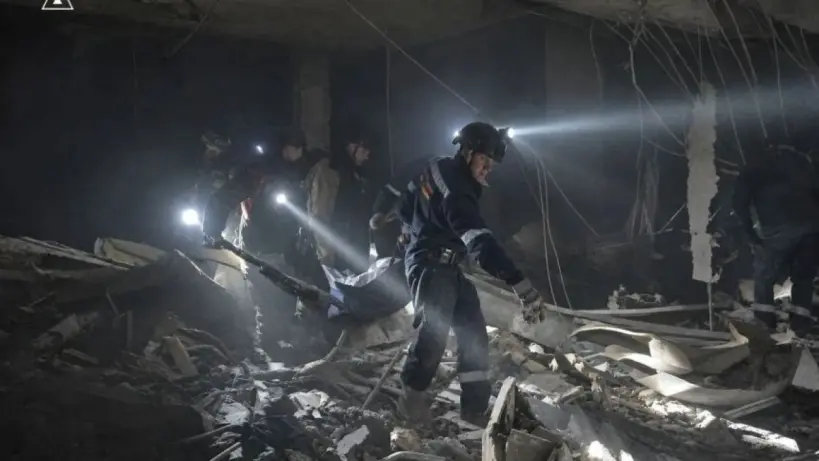
Rescuers carry the body of a person killed in the Russian airstrike in Komyshuvakha.
Mykhailo Semikin, the local governor, said civilians had gathered at the site in the Zaporizhzhia region to receive humanitarian assistance. The building had been a school, but was no longer operating as one after fighting moved closer to the village and many residents left. Local authorities had instead used it as an administrative base and aid-distribution hub.
Those inside were sheltering in a newly built reinforced basement, funded by the European Union and intended to withstand most strikes, Semikin said. However, the force of the bombs caused the concrete structure to collapse and sparked a fire.
The UN Human Rights Monitoring Mission in Ukraine said the attack occurred as civilians from the area assembled for the aid distribution. Danielle Bell, who heads the mission, said the time and location of the distribution had been widely publicized.
“Either the Russian armed forces knew that there was a humanitarian distribution taking place, or they failed to take the most basic steps to find out what was happening in this village they were planning to attack. In either case, this attack seems to have violated the most fundamental principles of international humanitarian law,” Bell said.
The attack took place before Russia launched another large-scale assault involving hundreds of drones and dozens of cruise and ballistic missiles aimed at Ukraine’s energy infrastructure, Zelensky said. He said the barrage came despite repeated calls by US President Donald Trump for an energy ceasefire.
Energy Minister Denys Shmyhal said three drones were directed at a substation vital to the operation of the Khmelnytskyi Nuclear Power Plant. In a Telegram post, Shmyhal said such actions threatened nuclear safety across Europe and that Ukraine had notified the International Atomic Energy Agency, the UN nuclear watchdog.
“It is very telling that all of this is happening on the day of the US congressional elections. The Russians believe that America will not notice this signal from them. But such terror must be noticed and stopped,” Zelensky said Tuesday morning.
He added: “Ukraine must be helped to defend its skies, otherwise Russia will never stop its missile strikes. It is essential to help build peace honestly and reliably, and America can do that.”
The attacks came as the Trump administration renewed efforts to advance negotiations. US envoy Steve Witkoff recently met Zelensky in Norway before traveling to St. Petersburg for talks with Russian President Vladimir Putin.
Separately, first lady Melania Trump helped secure a ceasefire in the occupied Ukrainian city of Oleshky, allowing hundreds of civilians to be evacuated over the weekend, according to Trump’s office. The office said representatives of Russia and Ukraine would be brought together at the White House on Thursday, describing the planned meeting as “an extraordinary moment in American history.”
Rescuers killed in follow-up strike
The Komyshuvakha attack occurred Monday and followed a pattern in which an initial strike is followed by another after emergency workers arrive, according to the account provided in the source material.
Two first responders, identified locally as 44-year-olds Denys Konovalenko and Oleksiy Sushchevsky, were killed after going to the site of the first strike. Ukrainian police said at least four officers also died.
The officers were named as Mykhailo Buzhenko and Mykola Balanda, each of whom had served in the police for more than 20 years, and Mykhailo Romanov and Dmytro Besedin, both community police officers for more than a decade.
“(They) were helping local residents take shelter in an underground school. A treacherous follow-up strike trapped everyone who was trying to escape,” police said in a statement.
Semikin told Ukrainian national television that KAB-500 and FAB-3000 bombs were used in the attack. He said the latter was a three-ton aerial bomb containing nearly 1.5 tons of explosives and was primarily designed to destroy heavy concrete fortifications and bunkers.
The strike was among the deadliest since the war began, Zelensky said. The source material also described recent months as particularly deadly for civilians, with Russian aerial attacks increasing during the summer.
At least 33 people were killed last month when Russia struck two civilian buses in Kramatorsk, in the Donetsk region, according to an earlier report. In August, 38 people died after a Russian drone strike on an ammunition depot near the capital set off a large fire and explosions in a residential area near Kyiv. A coordinated Russian missile assault on Kyiv in July killed 33 people across the city, according to a separate report.
What do you think of this story?
Share your reaction, or help us correct a detail.




Thank you for being part of our community. Read our Comment Policy before posting.
Comments
Loading the conversation…