


Airports across the United States experienced major flight disruptions following a widespread communications failure affecting air traffic control systems on Friday, November 13, 2026.
US Airport Outage: Thousands of Flights Canceled After Nationwide FAA Ground Stop
United States
Font
Article text size
English fonts
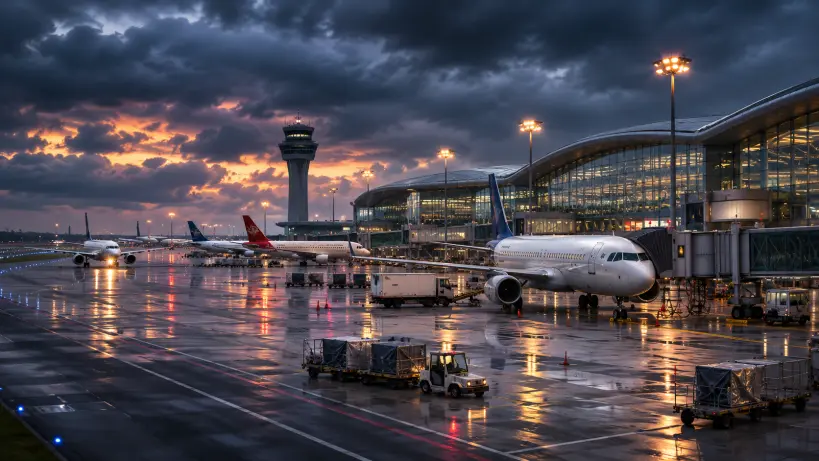
Airport disruptions
The Federal Aviation Administration, commonly known as the FAA, ordered a nationwide ground stop for departing aircraft as a precautionary measure to protect aviation safety.
The extraordinary decision disrupted domestic and international flight schedules, leaving airlines and passengers facing significant delays and uncertainty before authorities began allowing departures to resume.
According to figures reported by Reuters, more than 4,700 flights were canceled across the United States on Friday, while approximately 10,000 additional flights experienced delays.
Around 700 flights scheduled for Saturday, November 14, had already been canceled when the latest figures were reported, indicating that the effects extended beyond the initial shutdown.
These numbers reflected the situation at the time of reporting and could change as airlines continued adjusting their schedules and updating flight information.
US authorities explained that the nationwide ground stop followed a telecommunications failure involving air traffic control centers responsible for coordinating aircraft movements.
Aircraft already airborne were generally permitted to continue their journeys and land under air traffic control instructions, while departing flights on the ground were temporarily prevented from taking off.
The disruption affected operations at major airports, with significant consequences reported in cities including New York, Boston, San Francisco, and Chicago, as well as connections involving international destinations.
In a significant development, the FAA lifted the nationwide ground stop on Friday evening after the restrictions had remained in effect for more than four hours.
However, removing the restrictions did not immediately restore normal flight schedules, as airlines faced operational challenges involving aircraft positioning, delayed departures, and crew availability.
Aviation industry analysts warned that restoring regular operations could take additional time, with further cancellations and delays possible as carriers worked through the disruption.
Regarding the cause of the incident, the US Department of Homeland Security stated that there was no indication of a deliberate cyberattack based on the information available at the time.
Officials said investigations into the communications failure were continuing, while the incident renewed attention on the reliability of aging aviation infrastructure across the United States.
The disruption also raised broader concerns about communications resilience and the importance of modernizing systems used to manage the country’s heavily traveled airspace.
For travelers flying from Egypt, Saudi Arabia, the United Arab Emirates, Kuwait, or Bahrain to the United States, the incident could indirectly affect connecting services and subsequent travel arrangements.
No general suspension of direct flights between those countries and the United States was confirmed as a consequence of the outage, making individual flight verification essential.
Passengers are advised to consult their airlines and departure airports for the latest flight status before traveling, particularly when their journeys involve connecting flights or time-sensitive arrangements.
Source: Reuters, Federal Aviation Administration (FAA), ABC News
What do you think of this story?
Share your reaction, or help us correct a detail.





Thank you for being part of our community. Read our Comment Policy before posting.
Comments
Loading the conversation…