


Saudi Arabia’s Ministry of Human Resources and Social Development (HRSD) provides an electronic system through the Ajeer platform to regulate temporary employment arrangements and the use of workers by eligible establishments.
Saudi Arabia.. HRSD Explains Ajeer Temporary Work Permits and Employee Leasing Rules
Saudi Arabia
Font
Article text size
English fonts
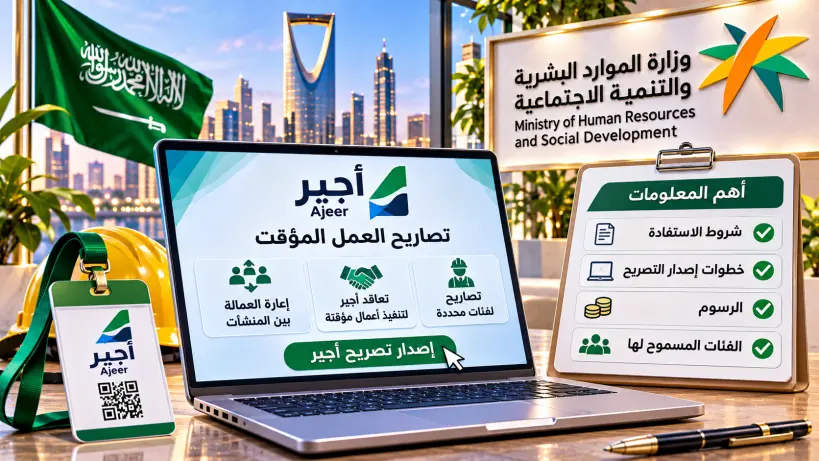
Temporary work permits in Saudi Arabia
The platform supports several types of services, including temporary employee leasing between businesses, subcontracting arrangements and permits designed for specific categories of workers.
These services are particularly important for employers seeking access to workers already present in Saudi Arabia and for expatriate residents whose employment circumstances may qualify for temporary work arrangements.
However, the availability of Ajeer does not mean that every expatriate may freely work for another employer without obtaining the required official authorisation.
What is an Ajeer temporary work permit?
According to HRSD, an Ajeer permit is an electronic legal document allowing an eligible worker to perform work at a specified establishment for a temporary and defined period.
The programme helps businesses respond to workforce demand by using eligible workers already available in the Saudi labour market rather than relying exclusively on recruitment from abroad.
Ajeer supports different forms of temporary and seasonal employment, with the appropriate permit depending on the relationship between the establishments and the nature of the assignment.
A valid residency permit alone is not sufficient to authorise temporary work for another employer, as the applicable Ajeer procedures must also be completed.
Employee leasing between establishments
The Ajeer employee leasing service enables an establishment to assign a worker’s services temporarily to another eligible business for an agreed period ending with the relevant contractual arrangement.
This differs from the Ajeer contracting service, which allows subcontracting companies to organise the presence of their employees at a client’s worksite while carrying out contracted activities.
The two services therefore have different purposes and may involve separate eligibility checks, contractual requirements and permit conditions.
Ajeer also provides a specific leasing option for individual establishments employing between one and five workers, subject to the rules published for that service.
Conditions for businesses and workers
The ministry’s service guidance identifies several eligibility requirements for temporary work arrangements, including the establishment’s operational status and applicable Nitaqat classification.
Certain employee leasing services require the establishment not to fall within the red Nitaqat category, alongside conditions concerning the number of leased workers and their previous period of residence in Saudi Arabia.
For Ajeer contracting, the published guidance identifies relevant activities such as construction, maintenance, cleaning, catering and consulting services under the applicable contracting framework.
These requirements should not be treated as universally applicable to every Ajeer permit because the platform operates additional services with separate eligibility criteria.
How to apply for an Ajeer permit
The application process generally begins when an authorised business user signs in to the Ajeer platform and opens the contracts section.
The user then creates a contract, selects the required service, enters information about the beneficiary establishment and specifies the contractual terms and duration.
After the relevant party approves the contract, the applicant proceeds to the permits section, selects an active contract and adds the workers who will be covered by the temporary authorisation.
The user must review the details, accept the applicable terms and complete any required payment process before relying on the permit as valid.
Are Ajeer permits free of charge?
The general Ajeer permit issuance service listed on HRSD’s official website is described as free of charge, with an indicative service completion period of five working days.
However, individual services listed on the Ajeer platform, including certain contracting and leasing arrangements, indicate that charges can vary according to the requested permit duration.
Employers should therefore distinguish the ministry’s general service listing from the costs that may apply when using a specific Ajeer service.
The final payable amount should be checked within the official application process, together with any commercial obligations established between the participating businesses.
Can expatriate dependants obtain permits?
The platform also provides specific services allowing eligible expatriate dependants to work under defined conditions, separate from ordinary establishment-to-establishment leasing arrangements.
The HRSD service guidance requires both the dependant and the principal expatriate resident to have valid residency permits, and the dependant must be at least 18 years old.
Professional accreditation may be required where the occupation demands it, while the listed qualifying family relationships include spouses and certain designated relatives.
These conditions do not establish an automatic right for every dependant to work, because eligibility remains subject to the relevant permit category and the official system’s approval.
Important guidance for employers and expatriates
An Ajeer temporary permit should not be confused with a permanent transfer of employment services to a new employer, since the two processes involve different legal arrangements.
Employers and workers should also ensure that the relevant permit has been issued and that the assignment complies with its approved duration and scope before work begins.
The Ajeer platform provides information about available services, applications, contracts and permits, while support is available through the official telephone number 920011040.
Applicants should consult HRSD and the official Ajeer platform for current conditions, applicable charges and any subsequent amendments before entering temporary work arrangements.
Source: Saudi Ministry of Human Resources and Social Development
What do you think of this story?
Share your reaction, or help us correct a detail.
Thank you for being part of our community. Read our Comment Policy before posting.
Comments
Loading the conversation…