


Kuwait’s Public Authority for Civil Information has clarified the official procedures for replacing lost or damaged Civil ID cards belonging to expatriate residents, including the required documents, application channels and applicable fees.
Kuwait.. PACI Explains How Expatriates Can Replace Lost or Damaged Civil ID Cards
Kuwait
Font
Article text size
English fonts
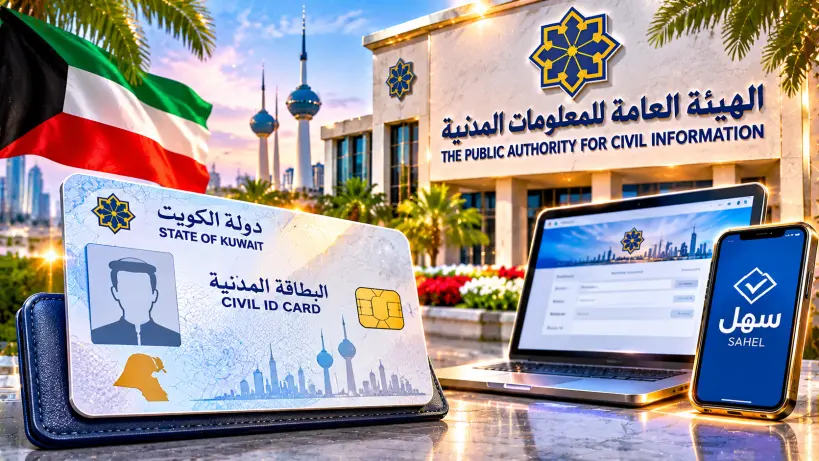
Kuwait.. PACI
The service is particularly important for foreign residents because Civil ID cards are widely used for identity verification and numerous administrative transactions throughout the country.
The authority allows eligible applicants to request replacement cards through approved government channels, including the Sahel application and designated customer service centres.
Understanding these procedures can help expatriates avoid unnecessary delays when their original identification card is missing or can no longer be used.
According to PACI’s official transaction guide, a non-Kuwaiti resident may submit a replacement application personally or through an authorized representative holding an official power of attorney issued by the Ministry of Justice.
The application may also be initiated through the Sahel government application, subject to the requirements applicable to the individual transaction.
For applicants under eighteen years of age, a parent or legal guardian must attend where the service conditions require personal attendance, including relevant custody arrangements following divorce.
Residents should select the service specifically designated for non-Kuwaiti individuals rather than the separate procedures available to Kuwaiti or Gulf Cooperation Council nationals.
Regarding supporting documents, the authority requires the applicant’s original valid passport together with a copy.
The passport information should be accurate and consistent with the details recorded in the civil information system to support successful processing.
Where an authorized representative submits the application, the relevant official power of attorney requirements must also be satisfied.
Applicants are advised to check their passport validity and personal information before starting the procedure to reduce the risk of administrative complications.
The official fee for issuing a replacement Civil ID card because of loss or damage is KWD 20 for a non-Kuwaiti individual.
Payment can be completed through the authority’s official website or the Sahel application, using the available electronic payment channels.
This amount should not be confused with the ordinary Civil ID renewal charge, because replacement and renewal are different government services.
Electronic application options also do not automatically remove the requirement for identity verification or any applicable supporting documentation.
PACI identifies several locations for the service, including its headquarters in South Surra and the government service facilities at Liberation Tower.
The listed locations also include branches in Ahmadi, South Sabahiya, and Jahra, allowing eligible applicants to use different designated customer service centres.
Individuals choosing in-person attendance should confirm the working hours of the relevant centre before visiting, as schedules may differ between locations.
The authority’s service guide lists an evening period at the main headquarters from 3 PM to 7 PM, while the government portal also provides instructions for morning visits to the expatriate registration office.
Additional electronic services allow residents to check their Civil ID application status and monitor whether their replacement card is ready.
In May 2026, PACI also announced a QR-code collection feature through the Kuwait Mobile ID application for eligible first-time issuance and lost-card replacement cases.
The feature allows users to receive a readiness notification and complete verification steps to obtain the collection code when supported.
Expatriates should use official government websites and applications and avoid sharing identity information or verification codes with unauthorized parties.
These procedures describe an existing government replacement service and should not be presented as a newly introduced fee or regulation on the article’s publication date.
Source: Kuwait Public Authority for Civil Information – Replacement of Lost or Damaged Civil ID for Non-Kuwaiti Individuals, Kuwait Government Online.
What do you think of this story?
Share your reaction, or help us correct a detail.
Thank you for being part of our community. Read our Comment Policy before posting.
Comments
Loading the conversation…