

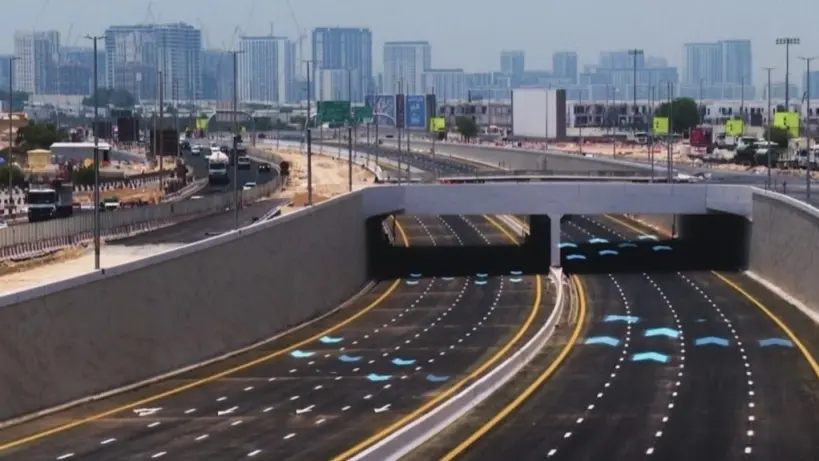
Dubai’s Roads and Transport Authority (RTA) has officially opened a major new tunnel on Umm Suqeim Street, aiming to ease congestion and improve travel times for motorists.
The 800-metre tunnel features four lanes in each direction and is designed to handle up to 16,000 vehicles per hour.
The newly inaugurated tunnel is part of the broader Umm Suqeim Street Development Project, which extends from Al Khail Road to Sheikh Mohammed bin Zayed Road. This critical infrastructure upgrade is expected to improve connectivity across several densely populated areas, including Dubai Hills, Arjan, Dubai Science Park, and Al Barsha South 1, 2, and 3-benefiting over one million residents.
Significant Travel Time Reduction Across Strategic Corridors
Mattar Al Tayer, Director General and Chairman of the Board of Executive Directors at RTA, emphasized the strategic importance of the tunnel, noting that it connects four major corridors in Dubai: Sheikh Zayed Road, Al Khail Road, Sheikh Mohammed bin Zayed Road, and Emirates Road.
“This upgrade boosts Umm Suqeim Street’s capacity to 16,000 vehicles per hour in both directions and reduces travel time between Sheikh Mohammed bin Zayed Road and Al Khail Road by 61%-from 9.7 minutes down to just 3.8 minutes,” Al Tayer stated.
Project Scope Includes 4.6km of Road Enhancements
The full scope of the Umm Suqeim Street Development spans 4.6 km and includes the reconstruction of the intersection at Al Barsha South Street near Kings’ School. Alongside the newly opened underpass, a signalised surface-level intersection was also constructed to support smoother traffic flow.
The project is part of a long-term strategy to enhance the Umm Suqeim–Al Qudra corridor, which runs 16 km from Jumeirah Street to Emirates Road. According to Al Tayer, this corridor plays a key role in connecting east–west roads with Dubai’s major north–south routes.
Smart Technology and AI Deployed During Construction
RTA incorporated cutting-edge technologies in the project’s execution. Drones powered by artificial intelligence were used to gather real-time data, streamline decision-making, and reduce field survey time by 60%. Time-lapse imaging also improved monitoring efficiency by 40%, further accelerating construction progress.
Project Builds on Previous Infrastructure Milestones
This tunnel complements earlier phases of the Umm Suqeim Street upgrade. In 2013, RTA delivered Phase I of the project, which included two three-lane bridges and upgraded intersections at Al Asayel Street and First Al Khail Road. Additionally, three pedestrian bridges were constructed to improve safety between Al Quoz and Al Barsha.
In 2020, RTA also completed a 500-metre bridge near the Dubai Hills Mall entrance to serve the Dubai Hills and Al Barsha South areas. That bridge, like the new tunnel, supports up to 16,000 vehicles per hour and was developed to meet rising demand in the growing community.






Comments
Log in to write a comment