

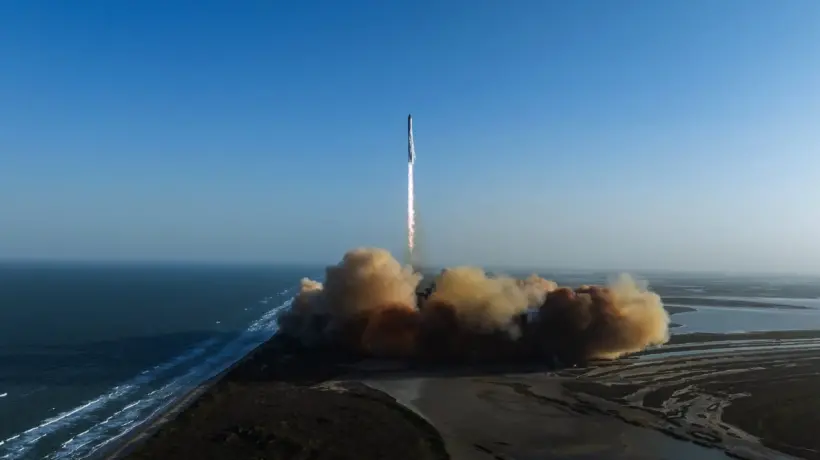
After a series of explosive setbacks, SpaceX attempted to launch its colossal rocket, Starship, once again on Tuesday evening. Unfortunately, the mission faced significant challenges when the spacecraft spiraled out of control and ultimately disintegrated.
The 123-meter rocket launched during its ninth demonstration from Starbase, the SpaceX facility located at the southern tip of Texas. Recently, local residents voted to establish the area as an official city.
Elon Musk's SpaceX anticipated deploying a series of mock satellites following the lift-off, but the attempt was thwarted when the spacecraft's door failed to open fully. Consequently, the rocket began to spin uncontrollably as it headed towards an erratic landing in the Indian Ocean.
SpaceX later reported that the spacecraft experienced what they termed a "rapid unscheduled disassembly," acknowledging that it had broken apart. In a public statement, the company remarked that "Teams will continue to review data and work toward our next flight test."
This launch marked the first instance in which one of Musk’s Starships-designed for lunar and Martian travel-utilized a previously flown booster. Unlike in earlier tests, there were no attempts to catch the booster with large nets upon its return. At one point, communication with the booster was lost, causing it to crash into the Gulf of Mexico in multiple pieces as the spacecraft continued en route to the Indian Ocean.
As the flight progressed, the spacecraft lost stability, apparently due to fuel leaks.
“Not looking great with a lot of our on-orbit objectives for today,” remarked SpaceX flight commentator Dan Huot. The team had aimed to evaluate the spacecraft’s heat shield during a controlled re-entry.
Communication was lost before the craft made its descent, leading SpaceX to promptly conclude its webcast.
The two previous iterations of Starship failed to reach past the Caribbean, with earlier demonstrations concluding just minutes post-launch, resulting in debris falling into the ocean. Fortunately, there were no injuries or serious damages reported, although airline traffic did face disruptions. Last week, the Federal Aviation Administration granted clearance for Starship’s next flight, broadening the hazard area while scheduling the launch for off-peak travel times.
In preparation for this flight, SpaceX made several adjustments, including modifications to the spacecraft’s thermal tiles and the installation of new fittings designed for capture. Although this Starship was intended to sink in the Indian Ocean, the company was keen to test these enhancements for eventually retrieving future versions back at the launch pad, similar to the booster approach.
Nasa has set its sights on SpaceX making significant advancements with Starship over the next year. This rocket is the largest and most powerful ever constructed and plays a crucial role in NASA's plans to return astronauts to the moon. Although next year’s mission will orbit the moon with four astronauts aboard, a lunar landing is not expected until at least 2027. This will require a Starship to transport two astronauts from lunar orbit to the moon’s surface and back again.








Comments
Log in to write a comment