

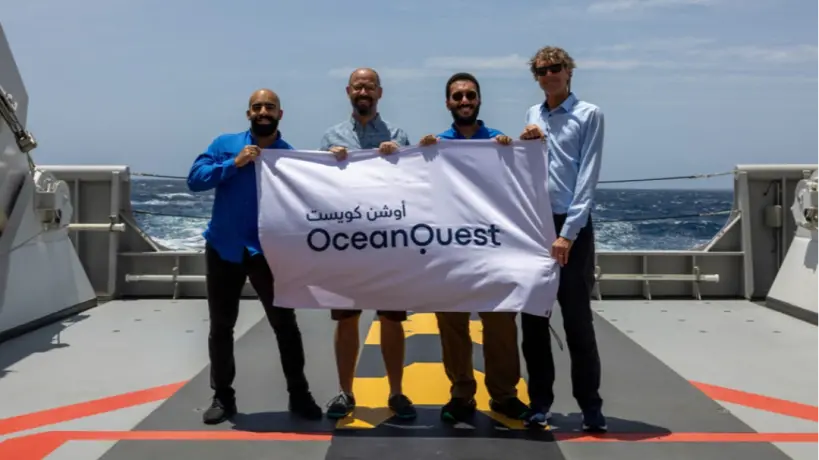
Saudi-backed OceanQuest aims to lead deeper exploration of oceanic frontiers, focusing on underwater mysteries, with a particular interest in the Red Sea and collaboration across the Global South.
Saudi Arabia steps into the spotlight with OceanQuest, a non-profit foundation set to revolutionize deep-ocean exploration. The initiative focuses on unraveling the mysteries of ocean depths beyond 200 meters in a bid to enhance understanding of one of Earth’s least explored frontiers.
In an exclusive with Arabian Business, Dr. Martin Visbeck, CEO of OceanQuest, discussed the foundation’s ambitious plans for technology-driven exploration and its aim to significantly influence the future of ocean science through inclusive global partnerships and local empowerment.
A New Era of Ocean Discovery
"OceanQuest was formed to explore the unknown, for both science and humanity," said Dr. Visbeck. "Our focus is on deep-sea environments such as seamounts – underwater volcanoes that are hotspots of biodiversity, affect ocean mixing, and may act as natural carbon sinks."
OceanQuest focuses on underexplored regions, including the Red Sea, Indian Ocean, and Tropical and South Atlantic, employing robotics, digital twins, and AI to pierce the secrets hidden beneath the waves. Their mission is to foster innovation, captivate public interest, and make deep-ocean science more accessible and consequential.
The Red Sea: A Natural Laboratory
Based in Saudi Arabia, OceanQuest places particular importance on the Red Sea. "This unique ecosystem is geologically young, warm, and saline, yet its depths remain largely uncharted," Dr. Visbeck explained.
By contrasting the Red Sea’s deep-sea features with seamount systems elsewhere, OceanQuest seeks global insights into patterns of biodiversity and resilience, amplifying the Red Sea's role in the global ocean narrative.
Collaboration Across the Global South
Central to OceanQuest’s mission is fostering equitable cooperation, with an emphasis on the Global South. The foundation has initiated early engagements in:
- Brazil: Collaborating with local scholars to study the Vitória-Trindade Seamount Chain and nurturing early-career researchers in Latin America.
- South Africa: Building on the Around Africa Expedition to extend partnerships with Mozambique, Tanzania, and Madagascar.
- Cape Verde: Continuing the exploration of regional seamount ecosystems while bolstering local scientific capacity.
"These are more than fleeting partnerships," noted Dr. Visbeck. "They’re investments in local leadership and shared access to deep-ocean science."
Investing in the Next Generation
Central to OceanQuest’s strategy is engaging early-career ocean professionals (ECOPs) through expedition training and global mentorship, setting the stage for future leaders in ocean governance and technology.
"Supporting ECOPs isn’t merely building capacity; it’s an investment in tomorrow’s ocean leaders," said Dr. Visbeck. This approach aligns with the UN Decade of Ocean Science for Sustainable Development, emphasizing youth engagement for lasting impact.
Technology as a Force Multiplier
OceanQuest is leveraging cutting-edge technology in its endeavors, deploying robotic systems to amass real-time imagery and data from seamounts.
This information populates digital repositories and digital twins-advanced simulations that precisely model ocean ecosystems. These technologies enable low-impact exploration, revolutionizing the interaction between scientists and the ocean.
"Storytelling connects science to society," Dr. Visbeck highlighted. Experience from first expeditions or new species discoveries becomes a means to make science engaging and impactful.
By transforming data into narratives, OceanQuest engages a global audience, underscores the ocean’s significance, and encourages a sense of communal responsibility.
Lessons from the Around Africa Expedition
OceanQuest’s inaugural project, the Around Africa Expedition with OceanX, yielded invaluable insights:
- African Scientific Leadership: Regional scientists led aboard the OceanXplorer vessel.
- Collaborative Research: Creating high-caliber data and discovering new marine life.
- ECOP Training: Educating over 30 early-career professionals with demand suggesting expanding opportunities.
The expedition corroborated OceanQuest’s collaborative, capacity-building model for ocean science.
Looking Ahead to the 2025 UN Ocean Conference
At the 2025 UN Ocean Conference, OceanQuest will highlight the deep ocean’s climatic, ecological, and sustainable roles. The foundation will advocate for increased focus on seamounts and deep-ocean ecosystems within global marine research agendas.
With the spotlight on SDG 14 (Life Below Water) and new ocean governance frameworks like BBNJ, Dr. Visbeck asserts that this is an opportune moment for a deep-ocean initiative like OceanQuest.
"Deep-sea exploration reveals unparalleled opportunities-from climate insights to biotechnological innovation," he stated. "With Saudi support and international cooperations, our mission is to turn exploration into progress for humanity."
Brand View enables our partners to share content with Arabian Business readers.
The content is supplied by Arabian Business Brand View Partners.








Comments
Log in to write a comment