


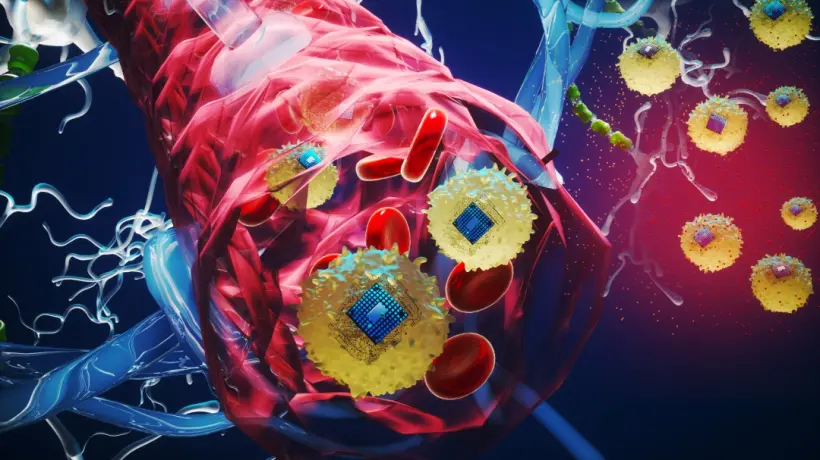
Researchers have developed microscopic electronic devices that hitch rides on immune cells to reach inflammation sites, avoiding the need for invasive procedures.
Conventional brain implants typically employ electrodes that penetrate the gray matter to stimulate and monitor neuron activity. These generally necessitate a surgical procedure for placement. To circumvent this requirement, a research team led by MIT assistant professor and electrical engineer Deblina Sarkar has pioneered microscopic electronic devices that merge with living cells. These hybrid cells can be injected into the bloodstream with an ordinary syringe, traveling through circulation until they implant themselves at targeted brain regions.
"During the initial two years of developing this technology at MIT, we faced 35 consecutive grant rejections," Sarkar shared. "Reviewers noted our idea's potential impact but deemed it impossible." She admits their proposal resembled something from science fiction literature. Nevertheless, after more than six years of dedicated research, she and her colleagues successfully realized their concept.
Challenges in Nanobot Development
In 2022, following promising preliminary data from cell-electronics hybrids, Sarkar's team submitted their project for the National Institutes of Health Director’s New Innovator Award. Remarkably, after countless rejections, they succeeded in passing peer review with the highest impact score recorded so far.
The high score was attributed to resolving three particularly challenging issues. Foremost among these was creating functional electronic devices smaller than cells capable of circulating in human blood.
"Earlier attempts had limited success," Sarkar noted. "They involved inserting magnetic particles into the bloodstream and maneuvering them using magnetic fields." However, she emphasized that electronics differ fundamentally from mere particles. Using CMOS technology akin to computer processors allows these electronics not only to generate power from light like photovoltaics but also perform necessary computations for intelligent applications such as sensing-capabilities simple particles lack.








Comments
Log in to write a comment