

AI specialists emphasize its role as a tool, warning against allowing it to control human creativity and decision-making.
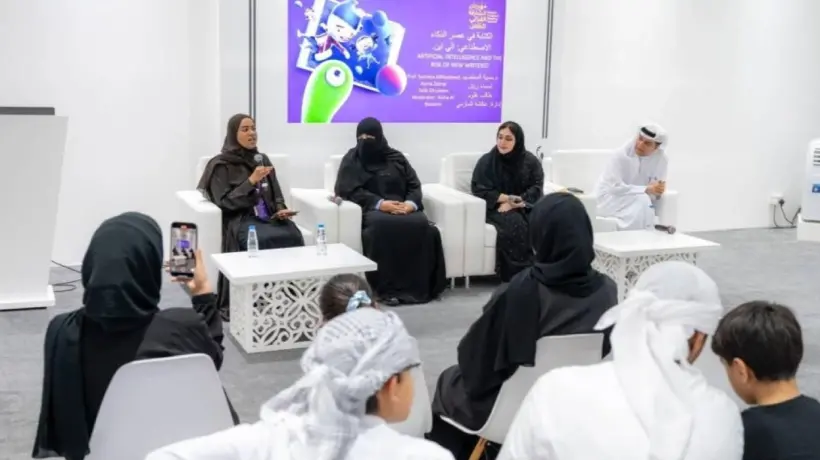
Experts in artificial intelligence and future studies highlighted the ethical and conscious usage of artificial intelligence during a recent panel discussion called "Writing in the Age of Artificial Intelligence: What's Next?" at the 16th Sharjah Children's Reading Festival. Emphasizing the need of keeping AI as a supportive tool in areas like writing, creativity, and education, they warned against having it think on behalf of people.
Moderated by Aisha Al-Mazmi, the session included writer and researcher Taleb Ghaloum, Emirati author and future studies researcher Asmaa Zainal, and Dr. Sumaya Al-Ma'adeed, a computer science professor at Qatar University.
With almost 80% of people, including many university students, using it, Dr. Al-Ma'adeed underlined that artificial intelligence is an extension of the Fourth Industrial Revolution. She underlined that this common use creates academic issues that call for educational institutions to create their tools to maintain academic integrity.
She said, "AI is a great tool for study and thinking, but it lacks human emotions and experiences. Much as some worldwide corporations that have set rigorous limits to safeguard their data, hence we have to educate kids to use it deliberately and promote openness when they depend on it.
Writer Asmaa Zainal, on the other hand, cautioned against the irresponsible use of artificial intelligence in writing and media, suggesting two possibilities: one being casual and thoughtless, the other being sensible and regulated.
She said, "Although artificial intelligence can provide fresh viewpoints in study, it should never supplant human intelligence or be let to decide for us. Though it cannot give feelings, it can improve looks. Our knowledge, not only its technical skills, determines the future of this technology.
Emphasizing the requirement of respect for literary authorship and openness in disclosure, writer Taleb Ghaloum underlined the need of unambiguous rules controlling AI use. "As long as there is recognition of AI's involvement in the work to guarantee integrity and prevent plagiarism, he said, generating hybrid texts in cooperation with AI causes no harm.
The seminar ended with agreement that artificial intelligence should stay a conscious tool utilized inside defined ethical frameworks in an always changing society rather than replacing people.






Comments
Log in to write a comment