


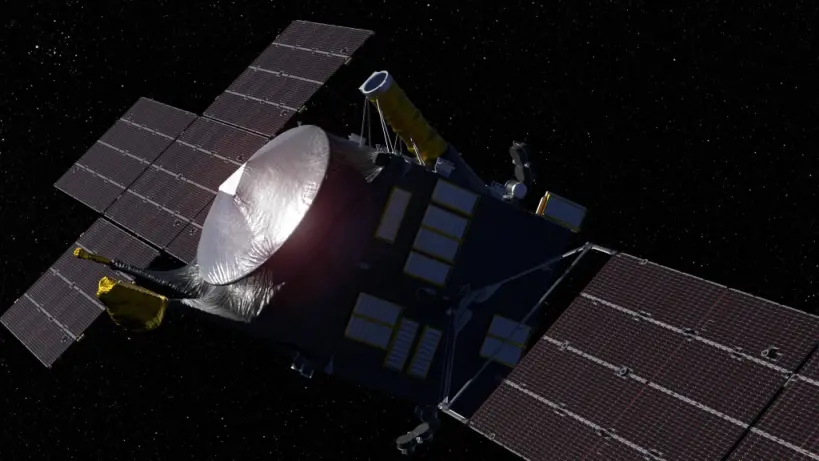
An illustration depicts a NASA spacecraft approaching the metal-rich asteroid Psyche.
Though there are no plans to mine Psyche, such asteroids are being eyed for their valuable resources. Credit: NASA/JPL-Caltech/ASU
The Psyche spacecraft utilizes electric thrusters, each generating just 250 milli-newtons of thrust, comparable to the weight of three quarters.
However, these thrusters are capable of continuous operation for extended periods, making them more efficient for long-distance space travel than traditional rocket engines.
These plasma thrusters are crucial for guiding the Psyche spacecraft on its journey to the metal-rich asteroid, also named Psyche.
The spacecraft's propulsion system comprises four Hall effect thrusters sourced from the Russian company Fakel, alongside various components including controllers, xenon fuel tanks, propellant lines, and valves produced by other manufacturers and Maxar Space Systems, the primary contractor based in California.
Psyche is set to first navigate to Mars, employing the planet’s gravitational pull next year to maneuver into the asteroid belt, with an anticipated arrival and orbital insertion around the asteroid in August 2029.
The Psyche mission was launched in October 2023 aboard a SpaceX Falcon Heavy rocket, marking the commencement of a six-year expedition through the Solar System.
The mission's total expenditure exceeds $1.4 billion, encompassing spacecraft development, launch operations, and an experimental laser communications package accompanying Psyche on its deep-space journey.
Occupying an orbit between Mars and Jupiter, the asteroid Psyche-approximately the size of Massachusetts-remains unvisited by any spacecraft.
Of the nearly one million asteroids cataloged, only nine are believed to possess a similar metal-rich composition.
The team behind the Psyche mission has limited insights into the asteroid's characteristics and anticipates an element of surprise at its arrival in 2029.
Metallic asteroids like Psyche present a riddle; much of their nature remains speculative, based primarily on estimations of density and composition.
Artistic interpretations of Psyche's surface, showcasing features unlike those found on rocky planets-such as jagged spikes and grooves-have fueled excitement in advance of the mission.
In just over five years, assuming the propulsion issue is resolved, scientists expect to replace conjecture with definitive findings about Psyche.








Comments
Log in to write a comment