


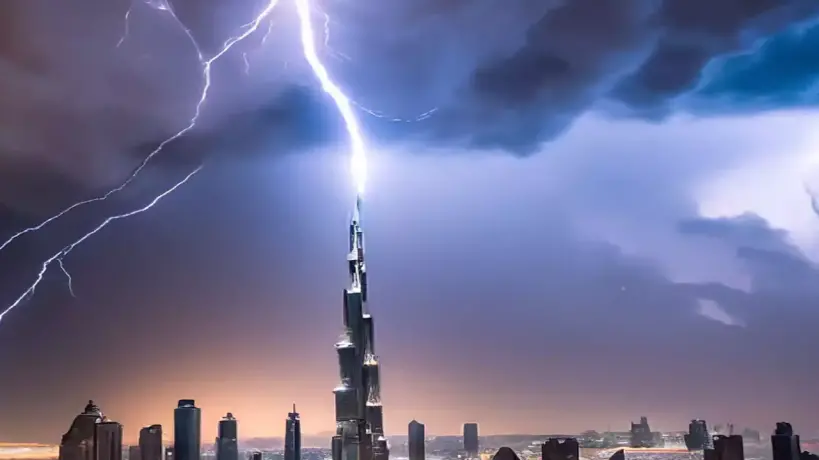
Stunning images of massive lightning strikes hitting the Burj Khalifa during recent storms in Dubai have been circulating widely on social media platforms in recent hours. This has led many to wonder: how does the world's tallest building survive millions of volts without sustaining a scratch?
While the scene may seem like something out of a science fiction film, it is, in fact, a marvel of electrical engineering.
What's truly remarkable is not just that the Burj Khalifa is immune to lightning strikes, but that it actively manages and controls atmospheric electricity through a sophisticated, invisible shield that protects everyone inside.
At 828 meters, the Burj Khalifa is essentially the world's largest lightning rod.
The tower's highly advanced shielding system begins at its summit. This summit is not merely decorative; it is equipped with specialized sensors and highly conductive materials designed to attract lightning strikes.
By "directing" the lightning strike to a specific point, the building ensures that the electrical charge follows a safe and controlled path to the ground, preventing damage to the tower's thin glass and steel facade or its internal electronic systems.
This is the true secret to the tower's robustness: the principle of the "Faraday cage."
The entire structure of the Burj Khalifa, including its massive steel frame and specialized aluminum cladding, is intricately interconnected.
This creates a continuous, conductive outer shell. Therefore, when lightning strikes, the massive electrical current flows around the building's exterior rather than penetrating it.
This phenomenon ensures that the residents, tourists, and cutting-edge technology inside—including the world's fastest elevators—are completely isolated from the powerful energy discharge occurring just inches away.
Once the lightning strike reaches the base of the tower, a sophisticated grounding system takes over, neutralizing the immense energy completely.
It should also be noted that a network of robust copper cables and rods, buried deep within the building's 50-meter foundations, safely distributes electrical charge into the ground.
This system is then monitored around the clock by smart sensors that track the intensity and frequency of each lightning strike.
This data helps engineers maintain the tower's long-term structural integrity and ensures the protection system is ready for the next storm.
This highlights the integration of human and technological expertise in Dubai's architecture, as this proactive approach to weather management is part of a broader vision for smart infrastructure in the UAE.
This approach is common across the country. As seen in Abu Dhabi's smart city rain management systems, Dubai's iconic landmarks are built with "digital resilience" in mind.
In conclusion, the Burj Khalifa's lightning system is a testament to the ability of human ingenuity to work in harmony with nature's most powerful forces.
What is truly astonishing is that for the thousands of people inside the tower during the storm, this invisible shield is the difference between a terrifying ordeal and a breathtakingly safe view of nature's power.








Comments
Log in to write a comment