


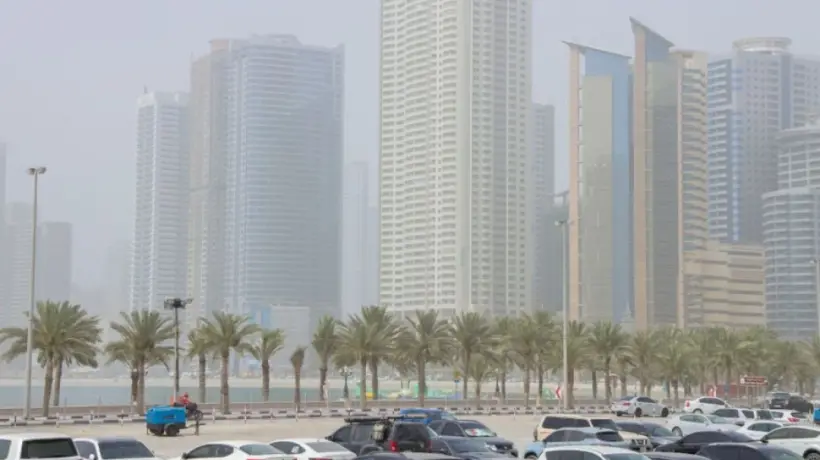
Several areas across the UAE experienced heavy fog yesterday morning, leading to a significant drop in horizontal visibility - in some places to less than 100 meters - and causing delays and slow-moving traffic.
Amid early warnings issued by meteorological and police authorities regarding expected fog formation, a number of workplaces sent urgent messages to employees advising them not to rush and to arrive safely, given the severity of the fog.
The National Center of Meteorology (NCM) issued an alert warning of fog formation and near-zero visibility across various coastal and inland regions.
Extensive Warnings for Drivers
The Ministry of Interior and Abu Dhabi Police urged motorists to drive cautiously during foggy conditions, adhere to the reduced speed limit of 80 km/h, maintain safe distances, and avoid distractions.
Abu Dhabi Police stated that it activated multiple alert systems, including smart gate screens, electronic signboards, social media alerts, early-warning mobile notifications, speed-reduction systems, and colored light signals.
Heavy vehicle, bus, and truck operators were also reminded to reinforce safety procedures and follow fog-related driving guidelines to prevent accidents.
Fog in the UAE: A Seasonal Phenomenon
Ibrahim Al Jarwan, Chairman of the Emirates Astronomical Society, explained that fog in the UAE typically peaks during two main seasons.
The first is in October and November, when fog may occur on more than 20 days a month, while the second is in March, which may witness over 15 foggy days. Lesser occurrences are also recorded in September and February.
He noted that fog forms when water vapor near the ground condenses as the air temperature reaches the "dew point."
This commonly happens late at night and during early morning hours when the ground cools rapidly under clear skies - a process known as "radiation fog," which is the most prevalent type in the UAE.
Al Jarwan added that fog formation is often linked to humidity levels exceeding 90% along with adequate cooling and the presence of condensation nuclei like dust and airborne particles.
He also highlighted other types of fog, including "rain fog" associated with rainfall, and "sea fog" which develops when warm maritime air moves into cooler regions.








Comments
Log in to write a comment