


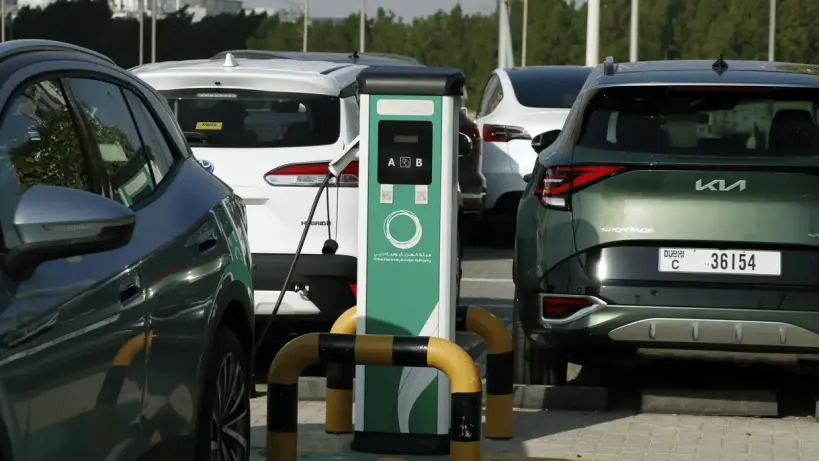
The Emirate is in the midst of building 400 electric vehicle (EV) charging stations over several locations, according to Abdullah Al Marzouqi, Director General of the Integrated Transport Centre (ITC), in Abu Dhabi.
This project fits Abu Dhabi's more general scheme to switch to greener energy and lower carbon emissions. On the last day of the Forbes Middle East Sustainability Leaders Summit in Abu Dhabi, Al Marzouqi discussed these specifics.
He underlined that public thoughts and proposals motivated half of the improvements in Abu Dhabi's transportation system. Public transport use rose by 17% in comparison to last year thanks to these contributions. Al Marzouqi's main point of emphasis is that 90% of the city's taxis are low-carbon or zero-emission vehicles nowadays. Complementing its more general environmental objectives, the city wants to have 100% low-carbon taxis by 2026.
Al Marzouqi said he was grateful for public and private sector cooperation in realizing creative ideas and projects. He underlined that the ITC is still open to public comments, especially with relation to bus lines and locations maybe not yet covered by public transportation. The creation of sustainable mobility solutions in Abu Dhabi has been much aided by this public-private cooperation.
Al Marzouqi gave a presentation on several projects and ideas meant to satisfy consumer needs as well as those of the larger society while supporting sustainable mobility during the second day of the Forbes Summit. He underlined the need of creative ideas in improving the public transportation system and help to lower carbon emissions. Abu Dhabi's continuous efforts to set EV charging stations to meet the rising demand help to support the major aspect of this strategy-the more use of electric vehicles.
Al Marzouqi's lecture similarly revolved mostly on urban planning and design. By include urban design features supporting electric automobiles and public transportation choices, he explored how cities may help to promote sustainable travel solutions. Abu Dhabi wants to lower its carbon footprint even more by building well-designed urban areas fit for walking, cycling, and public transport, so fulfilling the changing requirements of its citizens.
Given the ongoing demand for electric vehicles, the need for more EV charging stations is especially crucial. More people are choosing eco-friendly cars, thus sustaining this change depends on enough infrastructure. Al Marzouqi's announcement of 400 additional charging stations is unequivocally evidence of Abu Dhabi's dedication to enable the change to electric cars. While helping to allay range anxiety, the fear that an electric car will run out of before reaching a charging station, this infrastructural improvement is intended to make electric cars more accessible to citizens.
Al Marzouqi's presentation also underlined Abu Dhabi's more general objectives of using creative transportation ideas to build a greener, more sustainable future The city's concentration on lowering carbon emissions covers the whole urban scene in addition to public transportation and taxis. Abu Dhabi is projecting itself as a leader in sustainable transportation development by combining smart technologies and eco-friendly solutions.
Abu Dhabi's initiatives toward sustainable transportation and clean energy are making notable advancement. A key element of the city's more ambitious aim to lower carbon emissions and switch to low-carbon public transportation choices is the installation of 400 electric vehicle charging stations. Abu Dhabi is well on its way to create a greener future since 90% of its cabs now have low-emission and aims to reach 100% by 2026. The public and commercial sectors working together to shape these projects emphasizes the cooperative effort required to produce long-lasting, environmentally friendly transformation.





Comments
Log in to write a comment