


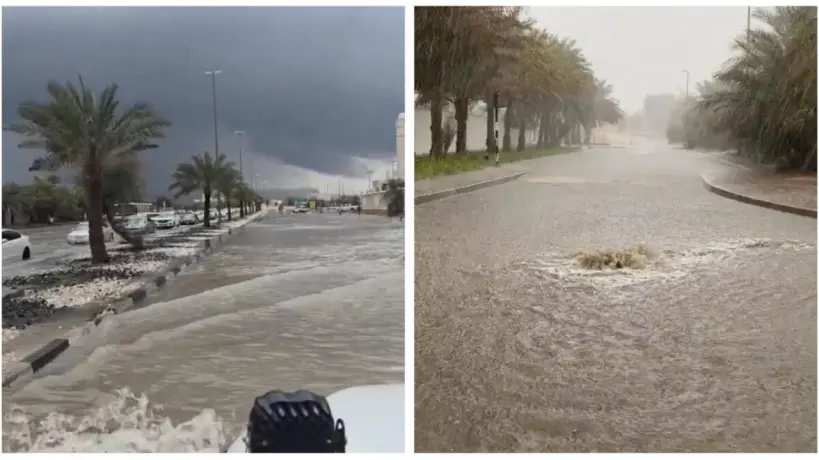
Parts of the UAE experienced a blend of weather conditions on New Year's Day, therefore signifying a different beginning to the year.
Anticipating wave heights in the Arabian Gulf of up to 9 feet, the National Centre of Meteorology (NCM) issued an alert for strong seas. Apart from this, people living in some areas were met with mild to moderate rain, lower temperatures, and hazy sky. Particularly in northern and coastal regions, these projected to be persistent weather patterns provided a contrast to the usually bright conditions the nation is known for.
According to the NCM's projection, areas of Dubai, Sharjah, and Umm Al Quwain would get more focused rainfall, Light to moderate rain showers started to fall in these locations on Wednesday as people commemorated the beginning of 2025.
Affected sites included the World Islands of Dubai, the Zorah neighborhood of Ajman, Al Salamah in Umm Al Quwain, and various Sharjah locations including Al Hamriyah, Emirates Road, and Wasit, Videos posted on social media by the Storm Centre, which emphasized the rainy conditions in sections of Umm Al Quwain and Sharjah, showed these areas seeing a range of rain intensities, from light showers to moderate rainfall.
Apart from the rain, the UAE's weather included light to moderate winds forecast to progressively intensify during the day, especially over the sea. These winds were expected to bring dust inland, therefore perhaps limiting visibility in several places. In the UAE, where outdoor events and celebrations had to consider the elements, this mix of rain and wind made for a less usual New Year's Day.
Temperature wise, the UAE had a notable decline; Jebel Jais in Ras Al Khaimah recorded the lowest temperature of 9.1°C, rendering this area the coldest on New Year's Day. Other areas of the nation, on the other hand, saw temperatures increasing to a more moderate 26°C, which reflects a minor but obvious fall in the warmth that is typical throughout the winter months in the region. This temperature variation paired to the odd beginning of the year provides a welcome relief from the customary heat that defines most of the UAE's climate.
Those preparing marine operations gave great thought to the state of the sea. The Arabian Gulf was predicted to see difficult to very rough conditions throughout the day, with wave heights reaching as high as 9 feet. For these dangerous circumstances, the NCM issued a warning and advised care to everyone exploring the sea. Conversely, the Oman Sea was projected to turn somewhat rough by late evening but remain rather mildly to moderately harsh. Further complicating matters for those out on the sea, fresh northwesterly winds were expected, perhaps reaching rates of up to 50 km/h.







Comments
Log in to write a comment