


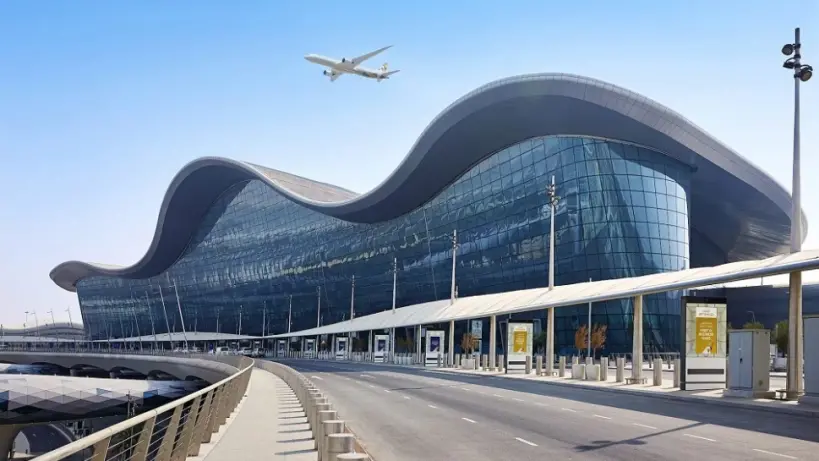
UAE airports, notably in Dubai and Abu Dhabi, are setting global standards with innovative technologies like AI and facial recognition to enhance efficiency and passenger experience, reducing check-in to departure times to just 12 minutes.
Selim Bouri, President for the Middle East and Africa (MEA) at SITA, a leading airport technology firm, has highlighted remarkable advancements at UAE airports, particularly in Dubai and Abu Dhabi.
These airports have set new global standards in innovation, enhancing efficiency and passenger experience.
Bouri emphasized the UAE's commitment to adopting cutting-edge technologies, particularly as airports face the challenge of managing increasing passenger volumes.
UAE Airport Technology Innovations
Bouri explained that SITA collaborates closely with UAE airports to address their unique needs and opportunities through tailored technology solutions.
He cited the implementation of the Smart Travel system at Abu Dhabi's Zayed International Airport.
This fully integrated platform utilizes biometric identity processing to reduce congestion and waiting times while improving airport capacity to accommodate a growing number of international flights.
With strong growth in flight traffic in 2024, Zayed International Airport has found it essential to adopt digital solutions to handle this surge.
Since the opening of its new terminal in November 2023, Zayed International Airport has processed over one million passengers using facial recognition.
This innovation has created a seamless digital identity for each traveler, enabling a swift journey from check-in to departure, including border control, in less than 12 minutes.
The success of the Smart Travel system sets a precedent for its implementation at other UAE airports.
Looking ahead, Bouri indicated that passengers can expect further advancements, with the expansion of biometric processing across various airport checkpoints.
This initiative aims to deliver a fully contactless passenger experience, focusing on efficiency and convenience.
Future enhancements will include self-service technologies such as self-check-in kiosks, automated baggage drop services, and smart boarding gates, all designed to alleviate congestion and streamline travel procedures.
Cybersecurity remains a top priority in the UAE's airport digital strategy.
Bouri underscored that smart innovations are vital to boosting efficiency, minimizing wait times, enhancing safety, and reinforcing the UAE’s stature as a leader in integrated smart airport systems.
Over the next decade, Bouri predicts a significant increase in the deployment of next-generation communication technologies within airports, which will foster a highly integrated smart airport ecosystem and flight operation network.
He noted the potential of 5G networks to enable seamless device-to-device communication, benefiting passengers and airport operations through enhanced ground connectivity. Future support is also expected for sixth-generation network technologies and advanced wireless internet services.
 Zayed International Airport in Abu Dhabi named most beautiful in the world
Airports, airlines, and governments in the Middle East are renowned for their leadership in innovation, investing substantially in new technologies to enhance passenger experiences and optimize airport operations. This includes biometric processing systems and e-gates supported by strategic initiatives and major investments.
Addressing the influence of artificial intelligence and big data on improving flight management and reducing delays, Bouri mentioned that although vast amounts of data are generated by airports, airlines, and partners, it is often underutilized.
In the coming decade, future-ready airports will increasingly depend on big data, predictive analytics, and advanced platforms to achieve optimal operational efficiency. Bouri clarified that the growing role of AI and robotics does not diminish human involvement but rather promotes smart collaboration between humans and technology.
The next decade will witness AI expanding into more sectors, including:
- Enhancing flight scheduling
- Personalized communication with passengers
- Operations center support
- Predictive maintenance
- Multilingual assistance
- Automated baggage handling
- Reduced fuel consumption for autonomous vehicles
AI will also be leveraged by airports and governments to enhance security screening and improve threat detection accuracy.







Comments
Log in to write a comment