


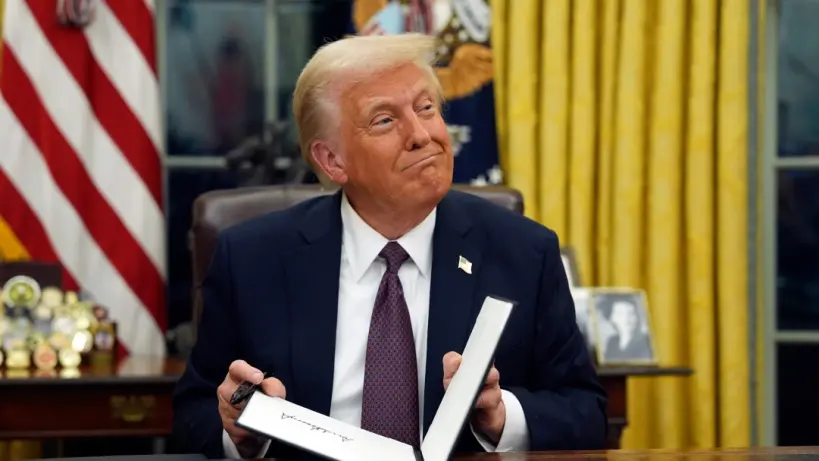
On Monday, President Donald Trump promises to reveal a fresh proposal to alleviate Americans' healthcare expenses.
This move comes as the government wants to avoid a dramatic increase in health insurance prices following the expiry of the Affordable Care Act's (ACA) primary subsidy program, according to three individuals familiar with the situation who spoke with CNN.
The idea seeks to fulfill Trump's promise to give a better option to enhanced benefits, which are depended on by around 22 million Americans.
The move comes after Democrats demanded an extension of benefits, resulting in a record-long government budget standoff.
Senate Republicans agreed to conduct a vote in mid-December to prolong the expanded benefits, which are slated to expire at the end of the year, in return for extending government funding until January.
This deal prompted Trump and his staff to develop a rival plan.
The ramifications of benefit expiry
The increased benefits scheme was implemented in 2021 as part of the Biden administration's COVID-19 relief package.
If these subsidies are eliminated, Americans' health insurance premiums are likely to more than double in the coming year, according to projections from the nonpartisan KFF Foundation, which specializes in healthcare policy.
The Congressional Budget Office predicts that an extra two million individuals will become uninsured next year.
Democrats intend to use these anticipated consequences as leverage against Republicans in the upcoming midterm elections, building on their previous success in the 2018 elections, when Republicans lost control of the House of Representatives after attempting to repeal the Affordable Care Act.
Proposed Controls and Amendments
The Trump administration's blueprint calls for a temporary continuation of the Affordable Care Act subsidies, with a set of regulations to limit their reach. Among the most notable ideas are a restriction on beneficiary income and a requirement that all registered persons pay a monthly premium.
These reforms are in reaction to persistent Republican criticism of the improved benefits system, notably zero-payment plans, which some claim encourage fraud and pave the way for a total overhaul of the system, as recently supported by Trump.
Republicans want to reestablish the income ceiling for recipients, which was originally four times the federal poverty threshold before being repealed in 2021 along with additional government assistance.
The elimination of the prior ceiling resulted in a huge increase of middle-class beneficiaries under Obamacare, who would be severely hurt if existing benefits were to expire at the end of this year.
The suggestions also include requiring all beneficiaries, including those with the lowest incomes, to pay a monthly charge to combat fraud connected to the supply of entirely free coverage through intermediaries or agents who enroll persons without their knowledge in order to earn commissions.
It is envisaged that setting a minimum premium will discourage such abuses in the future.
According to sources familiar with the topic, the proposal may also contain a provision for certain registered individuals to select less comprehensive insurance plans, allowing them to move a part of their federal benefits to their own private health savings accounts.
In recent weeks, Trump has called for direct federal financing to individuals to assist them in purchasing adequate private coverage, rather than diverting cash to insurance companies through traditional support programs.
In response to these proposals, Republican Senators Rick Scott (Florida) and Bill Cassidy (Louisiana) have introduced bills that would allow beneficiaries to withdraw a portion of their benefits and deposit them in health savings accounts, which they could then use to pay for doctor visits, prescriptions, and even eyeglasses.
Scott's plan would allow registered individuals to spend their whole benefit on any health care that best meets their requirements, whether under existing law or through less expensive and simpler policies.
Cassidy, on the other hand, want to have all benefits transmitted directly to personal accounts for usage in different medical services.
Meanwhile, Trump is anticipated to encourage Congress to pass his prior "most-favored-nation" prescription medicine policy into law.
The execution of this approach resulted in voluntary agreements with global pharmaceutical corporations to reduce medicine prices in the United States while linking them to reduced pricing in other affluent nations.








Comments
Log in to write a comment