


On Sunday, Syria moved significantly toward normalcy, opening classrooms all throughout the nation just one week following the spectacular fall from power of President Bashar Assad. Under Ahmad Al-Sharaa, the new government seeks to stabilize the country as it works through the consequences of 13 years of civil war that destroyed cities, wrecked the economy, and uprooted millions of people.
Most Arab countries' schools reopened on Sunday, the start of the workweek, according to officials. Students returning to schools from Damascus and other cities gave optimism to a nation long yearning for stability. Not all parents, however, were eager to send their kids back to school, citing questions about the precarious political climate and residual uncertainty.
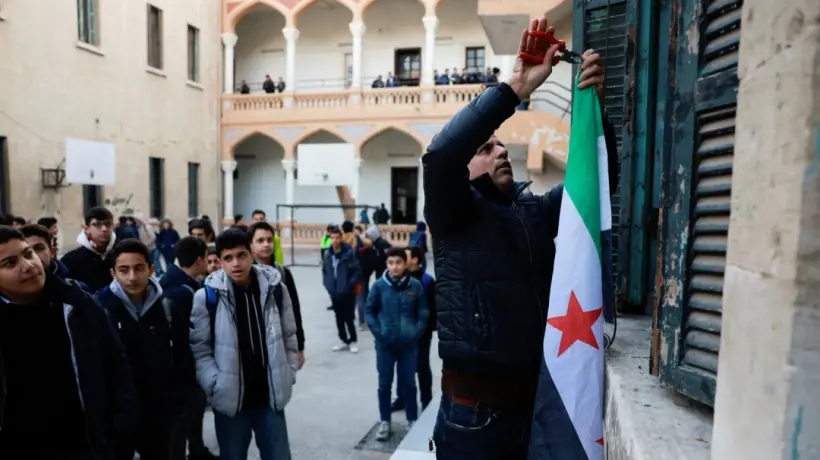
Students gathered in the courtyard of a boys' high school in Damascus were applauding as the school secretary, Raed Nasser, raised the newly adopted flag by the incoming government. Nasser confirmed that the Jawdat Al-Hashemi institution was ready to receive returning students. Emphasizing that the school stayed unharmed throughout the recent unrest, he stated, "We worked tirelessly for two to three days to ensure the school had everything needed for a safe return."
In a classroom, a kid hung the new flag on the wall to indicate a national rebirth. One returning student, Salah Al-Din Diab, showed relief. "I am quite happy and optimistic," he remarked. "I used to be constantly terrified of getting stopped at checkpoints or forced into military duty. I seem safer now.
Starting reconstruction of Syria, Ahmad Al-Sharaa, the new de facto leader, has enormous obstacles, Al-Sharaa leads Hayat Tahrir Al-Sham (HTS), an Islamist movement with a dubious past, under his militant moniker, Abu Mohammed Al-Golani. Once connected to Al-Qaeda, HTS is listed as a terrorist group by several states and under UN sanctions.
Notwithstanding these obstacles, the group has indicated that it wants to evolve beyond its militant beginnings and emphasizes rehabilitation and administration, Al-Sharaa and his government have to unite a nation while negotiating international mistrust, Neighbouring nations and world powers are reevaluating their policy toward Syria as the Assad government-which was largely supported by Iran and Russia-falls.
On his Sunday visit to Damascus, UN Syria envoy Geir Pedersen underlined the need of economic recovery. "A quick end of sanctions is crucial to facilitate Syria's rebuilding process," Pedersen said, hoping that lifting constraints will draw foreign funding for restoration projects.
Top officials from the United States, Turkey, the European Union, Arab countries, and Jordan gathered in Jordan to go over Syria's future course, US Secretary of State Antony Blinken underlined the need of the incoming government respecting minority rights and guaranteeing inclusiveness, This strategy conforms to global expectations on Syria's change to a stable and functional governing structure.
For Syria, restarting schools represents both a symbolic and pragmatic first step toward rehabilitation. The conflict has long hampered education; millions of children have been relocated and many of the schools have been damaged. Students returning to classrooms shows a larger attempt by the younger generation especially to bring normalcy back into Syrian life.
Still, there are really large challenges. For the new leadership, infrastructure destruction, a damaged economy, and the complexity of foreign relations provide continuous difficulties, Watching intently to see whether the new government can live up to pledges of governance, security, and respect of minority rights, Syria's neighbors and world powers remain wary.


Comments
Log in to write a comment