


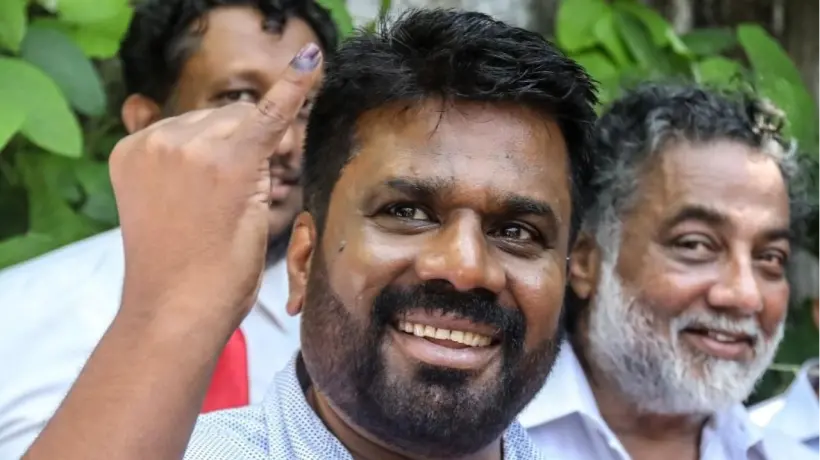
Anura Kumara Dissanayake was sworn in as the ninth president of Sri Lanka with fresh hopes for a turn around in the strife-torn economy and with promises to take on corruption at the Presidential Secretariat on Monday, where the oath of office was administered by Chief Justice Jayantha Jayasuriya.
The 56-year-old Dissanayake leads the Marxist Janatha Vimukthi Peramuna party and heads the National People's Power, a broader political coalition. He won against his main rival, Sajith Premadasa, who hailed from Samagi Jana Balawegaya, popularly referred to as SJB. It was a turning point in Sri Lanka's political calendar, as this election comes for the first time after huge protests led to the fall of former President Gotabaya Rajapaksa in 2022. All that was a direct result of the severe economic chaos faced by the country.
This election, in itself, came with one rather peculiar fact: the Sri Lanka Election Commission had to hold a second round of vote counting because no candidate reached the required 50% of votes in order to be declared the winner on the first attempt. Finally, Dissanayake won the presidency with approximately 5.74 million votes and an impressive 105,264 preferences, with Premadasa receiving about 4.53 million votes with 167,867 preferences.
Meanwhile, Prime Minister Dinesh Gunawardena resigned with the promotion of Dissanayake, reflecting a wider change in government after the presidential election. This transition aims to address pressing issues facing Sri Lanka, including huge economic difficulties that have left its people in uncertainty and hardship.
Coming into the presidency, Dissanayake faces an uphill struggle to restore vitality to the economy and to regain public confidence in government. The party's election promises of radical changes to reduce corruption and ineptitude that have been a part of Sri Lankan politics for many years are yet to be seen. Hopefully, under his leadership, the country will pass through its recent crises and emerge to build a more transparent and accountable government.
The expectations after the election are hence high for some immediate action. Dissanayake's supporters are getting anxious to see how his regime would move ahead, taking up the challenges, especially on economic recovery and governance reforms. Failures in the previous administration have created a situation of urgency among the public for effective leadership that gives adequate priority to the needs of the people.
Given the great expectations of the circumstances, the new president will thus be under close examination on his attitude to economic policy. Rising public unhappiness, shortages of basic necessities, and an inflation crisis have beset Sri Lanka. Dissanayake's first actions will thus be crucial in determining the tone of his leadership and establishing his will for significant transformation.
Furthermore, trying to bring a country ripped apart by recent political events together would depend much on D. Nissanayake's political strategy and leadership approach. For his government, his ability to create alliances within the fractured political terrain would be quite crucial. Along with economic recovery, the new government is probably going to address more social concerns that have generated upheaval among the general public.
Anura Kumara Dissanayake's inauguration marks a turning point for Sri Lanka and calls for strong leadership by him in these ongoing difficulties. Anura Kumara's triumph marks a transformation in the political scene of the nation, which is supposed to bring fresh reforms and openness in government. Therefore, the next few months will be quite important in deciding how far Dissanayake can rise to meet the great expectations his people have in him for guiding Sri Lanka toward development.




Comments
Log in to write a comment