


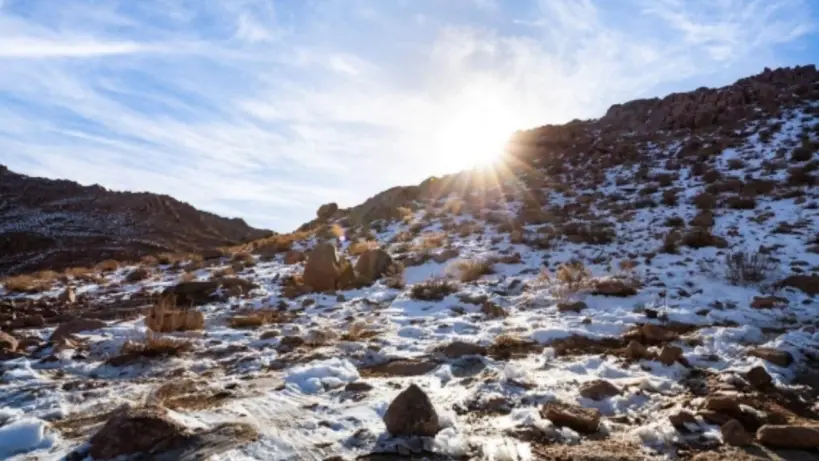
Officially starting on Saturday, the Jeddah Astronomical Society reports that the winter season lasts 89 days and brings cooler temperatures.
This seasonal change is strongly related to the winter solstice, which happened on Saturday, December 21 at 12:20 p.m. Makkah time. On the Northern Hemisphere, the winter solstice marks the shortest day and longest night of the year. Today marks the summer solstice in the Southern Hemisphere and the astronomical beginning of winter in the Northern Hemisphere when the sun beams squarely over the Tropic of Capricorn.
Head of the Jeddah Astronomical Society Eng. Majed Abu Zahra clarified the scientific basis of this event. He underlined that the Earth's axial tilt of 23.5 degrees together with its orbit around the sun produce the winter solstice. The four seasons result from this axial tilt allowing the Northern and Southern Hemispheres to alternately receive different quantities of sunshine throughout the year. Against popular assumption, seasonal variations on Earth are driven by its tilt rather than its distance from the sun.
Shorter daylight hours and cooler temperatures result from the Northern Hemisphere tilting away from the sun during the winter solstice. The Southern Hemisphere, which points toward the sun, gets more sunshine and milder temperatures in meanwhile. Abu Zahra also pointed out that the North Pole is slanted most away from the sun on solstice day. Consequently, sites north of the equator have days shorter than twelve hours, whereas those south of the equator have longer days surpassing twelve hours.
Saudi Arabia's winter arrives accompanied by notable variations in temperature patterns. From Sunday through Tuesday, the National Center of Meteorology (NCM) forecasts a chilly air mass influencing the northern border areas-including Tabuk, Al-Jouf, and Hail. Minimum temperatures in these regions should range from zero to minus four degrees Celsius, indicating a significant drop in mercury levels.
Starting Saturday over Tabuk, Al-Jouf, the Northern Borders, Hail, and Al-Qassim, the NCM also projects another temperature dip. Especially in the Riyadh and Eastern Provinces, these chilly conditions will be accompanied by active surface winds sufficient to stir up dust and dirt. Additionally likely to affect locations inside the Makkah and Madinah regions as well as sections of the Najran area are the dusty conditions.
Some southern parts of Saudi Arabia will also see other weather conditions outside the lower temperatures and sandy winds. Over portions of Jazan, Asir, and Al-Baha, the sky are predicted to be partially cloudy to opaque. Early winter's dynamic and changeable weather scene is shaped in part by these locations' modest rainfall and fog development.
The astronomical winter solstice and notable weather variations define Saudi Arabia's arrival of winter. The four seasons are created in great part by the tilt of the Earth's axis; the Northern Hemisphere today has shorter days and cooler temperatures. The NCM's projected cold air masses, temperature dips, and dust-laden winds mirror the several climatic variables linked with this season. People living in different areas should get ready for cold temperatures, poor vision brought on by dust, and maybe light rain and fog in some southern areas. As Saudi Arabia welcomes the colder months of winter, this time emphasizes the need of keeping updated about weather forecasts.







Comments
Log in to write a comment