


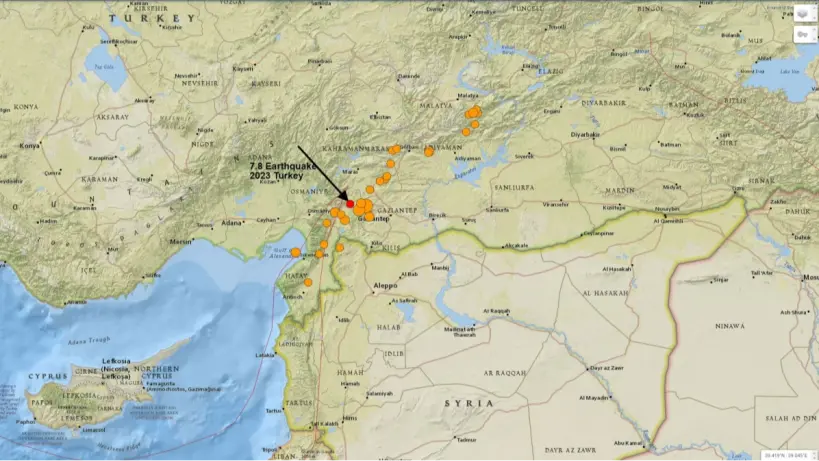
On Wednesday, Turkey's eastern part had a strong earthquake with a magnitude of 6.3 that felt vibrations across many surrounding nations. The European-Mediterranean Seismological Centre (EMSC) detected the earthquake, which happened local time at about 10:46 a.m.
It started at a quite shallow depth of 9 kilometers below the surface of the Earth, which most certainly had a major influence and experience of the trembles.
The EMSC estimates that almost 53 million individuals all over several nations experienced the seismic event. Apart from Turkey, where the earthquake started, reports of trembles were received in the Syrian Arab Republic, Georgia, Iraq, and Lebanon, covering a distance more than 400 kilometers. The great extent of the influence of the earthquake shows the strength and scale of the seismic waves.
Turkey, on multiple significant fault lines, is not unusual for experiencing earthquakes. In recent years, the nation has seen many major earthquake events that frequently cause a lot of damage and fatalities, Additionally seismically active are the areas around Turkey, which helps to explain the spread of earthquakes into Syria, Iraq, and Lebanon. Every one of these countries has a past of earthquakes, hence they are especially vulnerable when big quakes strike close by.
Early reports concentrated on the extent and geographic distribution of the earthquakes, but at the time of reporting further information regarding damage or casualties had not yet been verified, Particularly in places where buildings are not built to resist seismic activity, earthquakes of this degree usually causes significant damage, The actual degree of the devastation, meanwhile, might not be known right away as emergency teams survey the impacted areas start the process of recovery.
In Turkey, where earthquakes are a regular and fatal occurrence, officials are typically fast to react with search and rescue operations, medical treatment, and attempts to secure wrecked infrastructure, Neighbouring nations frequently rely on their own emergency response systems or communicate with Turkish officials as tremors sweep over borders to lessen the effects of the earthquake.
One of the nations experiencing the earthquakes, the Syrian Arab Republic is especially vulnerable because of the continuous conflict and unstable infrastructure condition, Years of violence have already deteriorated many Syrian buildings, which increases their vulnerability to collapse during seismic occurrences, Further complicating rescue efforts are earthquakes in Syria, which can tax the nation's meager resources and capacity for disaster response.
Though further from the epicenter of the earthquake, Georgia, Iraq, and Lebanon also claimed experiencing the shakes, Although these countries might not suffer the same degree of damage as those near the source of the earthquake, seismic activity of this kind can nonetheless create great disturbance and disturbance of everyday life, particularly in highly populated urban areas.
Tracking aftershocks and evaluating the likelihood of more seismic activity in the area, the EMSC, which tracks seismic activity worldwide, keeps tabs on Common after earthquakes of this kind are aftershocks, which can further damage buildings compromised by the first one.
While ensuring that any injuries or casualties are taken care of quickly, Turkey's disaster management officials will most likely be preoccupied with assessing the integrity of structures and infrastructure in the impacted regions, Apart from that neighboring nations affected by the earthquake should cooperate with foreign agencies to offer help and evaluate their own national requirements.








Comments
Log in to write a comment