


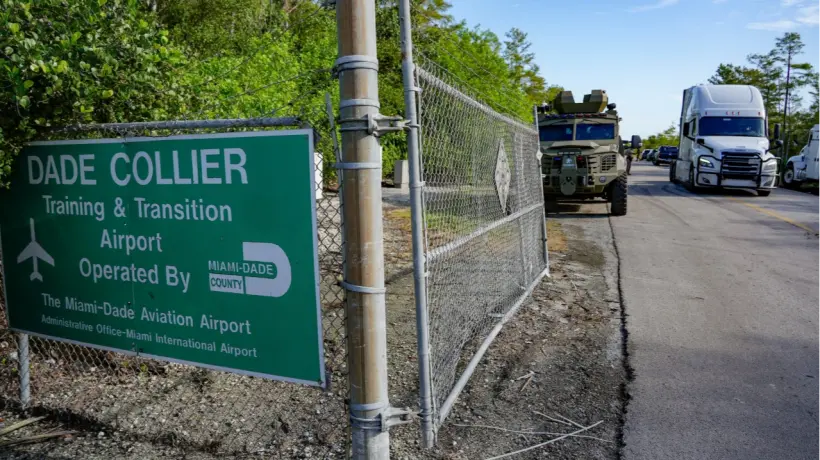
Florida has commenced housing immigration detainees at a new Everglades facility, dubbed 'Alligator Alcatraz.' Though state officials highlight its logistical advantages, human rights advocates criticize potential inhumane conditions. This move aligns with the Trump administration's immigration strategy, leveraging site isolation for deterrence.
Kevin Guthrie, director of Florida’s emergency management division, expressed confidence in the state’s ability to act swiftly without bureaucratic hindrances during emergencies. Speaking alongside Governor Ron DeSantis, he highlighted the application of this efficiency to the newly unveiled facility in the Everglades.
While some view the site as an effective measure to address immigration, human rights advocates argue that it equates to housing people in potentially inhumane conditions indefinitely.
According to DeSantis’ chief of staff, James Uthmeier, the location was chosen for its pre-existing infrastructure and natural barriers provided by the Everglades, akin to the infamous California island prison it is nicknamed after. The site serves not only as a logistical choice but as a deterrent against escape.
This development reflects the Trump administration’s strategy to persuade undocumented individuals to self-deport through intimidation.
Several businesses, including Lemoine CDR Logistics and CDR Health Care, owned by major Republican donor Carlos Duart, were hired for the project. While Duart confirmed his companies' involvement, he declined to detail their contributions due to a nondisclosure agreement, but emphasized the high quality of their services.
State contracts reveal that Granny’s Alliance Holdings Inc. signed a $3.3 million agreement for meal services, while IRG Global Emergency Management secured a $1.1 million deal for logistical support. Both companies have begun fulfilling their roles at the facility.
In a demonstration of its significance to the administration’s immigration policy, President Trump toured the site. The see-saw between ecology and immigration policy is exemplified by decades of efforts and significant funding aimed at Everglades restoration, now challenged by this new project.
Amidst environmentalist pushback, the federal government clarified via court filings that the U.S. Department of Homeland Security did not authorize or finance the detention center, which remains state-managed. Despite this, Florida intends to seek federal reimbursement.
Governor DeSantis maintains the facility is temporary with minimal environmental impact, asserting no plans for extensive infrastructure like sewers. His administration has reiterated this assurance in response to ongoing litigation.








Comments
Log in to write a comment