

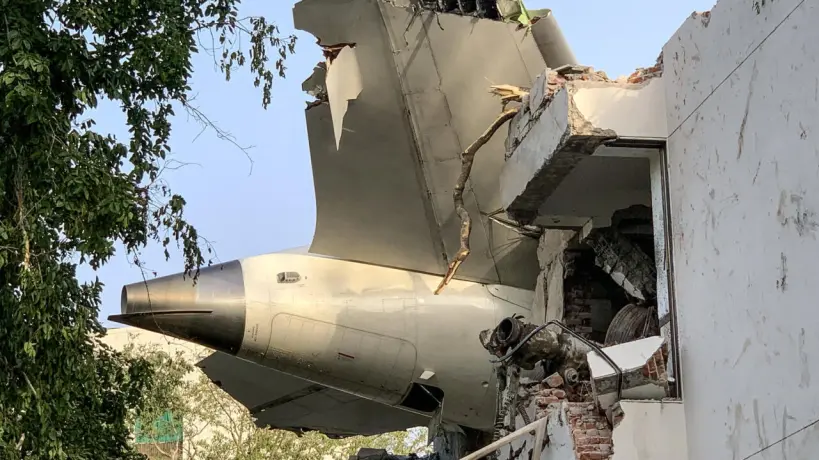
Investigators have recovered the cockpit voice recorder from the Air India flight that crashed shortly after takeoff from Ahmedabad, killing at least 270 people. This discovery, alongside the previously recovered flight data recorder, is crucial for determining the crash's cause. The investigation, led by India's Aircraft Accident Investigation Bureau with international collaboration, aims to provide clarity and prevent future incidents. Meanwhile, families remain in anguish as the identification process continues.
Investigators have successfully retrieved the cockpit voice recorder (CVR) from the wreckage of the Air India flight that crashed last week, marking a pivotal advancement in determining the cause behind the tragic accident.
The London-bound Air India aircraft, a Boeing 787-8 Dreamliner, met with disaster shortly after departing from Ahmedabad in western India on Thursday. The calamity claimed the lives of at least 270 individuals, most of whom were passengers.
The CVR is crucial as it documents audio from the cockpit, encompassing conversations between pilots, alarms, and various ambient sounds.
On the previous day, the flight data recorder (FDR), which records vital flight details like altitude, speed, and engine performance, was extracted from the debris.
These two instruments together are commonly referred to as the plane's "black box," despite actually consisting of two bright orange devices equipped with reflective strips for easy recovery post-crash. They are critical in aviation accident investigations by assisting experts in reconstructing the plane's final moments.
The investigation is being led by India's Aircraft Accident Investigation Bureau (AAIB), with support from teams in the US and UK.
On Sunday, representatives from the US National Transportation Safety Board (NTSB) visited the crash site.
"The AAIB has initiated a comprehensive investigation, while the NTSB is conducting a parallel inquiry under international standards due to the aircraft being American-made," a statement issued on Sunday elaborated.
Reports from Indian media indicate that officials from Boeing and the Federal Aviation Administration (FAA) have also inspected the site.
Meanwhile, an Indian government-formed high-level committee tasked with examining the causes of the crash is slated to convene for its inaugural meeting on Monday.
This committee is expected to deliver a preliminary report within three months, as reported by All India Radio, and suggest new standard operating procedures (SOPs) to avert such incidents in the future.
As these probes advance, families are left grappling with deep sorrow and disbelief.
The ill-fated AI171 flight crashed into a building housing doctors at BJ Medical College and Civil Hospital less than a minute after taking off.
All but one of the 242 passengers and crew members perished. Authorities are working to confirm the number of victims on the ground and are employing DNA testing to ensure precise identification of the deceased.
During the weekend, officials confirmed the recovery of 270 bodies from the site.
Dr. Rajnish Patel of Ahmedabad's Civil Hospital on Monday conveyed that more than 90 victims were identified through DNA matching, with 47 of those bodies having been returned to bereaved families.
Among those identified is Vijay Rupani, the former Gujarat chief minister, whose funeral will be observed with full state honors in Rajkot city on Monday.
For numerous families, the tormenting wait persists.
Officials disclosed to the BBC that the identification process remains painstakingly slow due to the severe burns on many bodies, necessitating processing in smaller batches.
Mistry Jignesh, awaiting news about his niece at the hospital, expressed his distress to the BBC, stating his wait has been extended beyond expectations due to ongoing recovery efforts.
"When people are still missing, how can they finish the DNA process by tomorrow? What if my niece's remains haven't even been located? The suspense is overwhelming," he lamented.







Comments
Log in to write a comment