

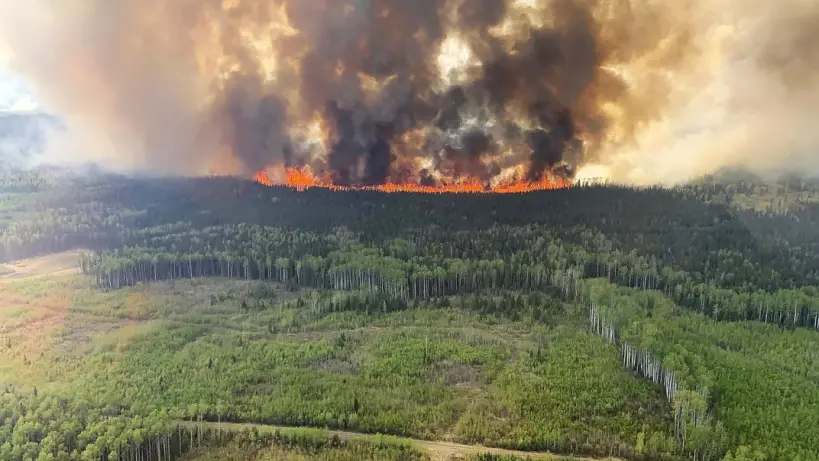
Wildfires raging across Canada have displaced thousands, affecting communities and industries as smoke clouds travel internationally.
Thousands of evacuees from Canada's wildfire-stricken regions have been allowed to carry only one bag each as they face weeks before possibly returning home. The province currently reports 25 active fires, including 10 classified as out of control.
As cities and First Nations communities struggle with scarce accommodations, many evacuees are being transported outside the province. Hundreds from the Pimicikamak Cree Nation have been flown to Niagara Falls, Ontario, where securing hotel rooms is becoming increasingly challenging.
In Lac du Bonnet, Manitoba, evacuation orders remain in effect following the mid-May report of two fatalities, just over an hour from Winnipeg.
Though cooler temperatures and mild showers have temporarily curbed fire escalation in Alberta, the week ahead forecasts warmer conditions. More than 4,500 residents, including the populace of Swan Hills near Edmonton, have been ordered to evacuate. Wildfires have consumed over 500,000 hectares, mostly in the province's northwest.
Alberta is contending with 53 active wildfires, 24 of which are out of control, while six are in a state where containment is anticipated under current circumstances. The province has recorded 505 wildfires this season.
The wildfires have adversely impacted Alberta's oil sands sector, resulting in the shutdown of around seven percent of Canada's oil output, equivalent to approximately 350,000 barrels per day.
Most of the fires are concentrated in northeastern Alberta. Prince George has issued a third evacuation order as winds exceeding 50 kilometers per hour threaten to intensify the fires towards the Alberta border. The region faces severe drought conditions, according to Agriculture Canada.
This week, significant cleanup efforts were initiated after fires near Summit Lake severed 160 km of the Alaska Highway close to Fort Nelson, British Columbia. The vital route, linking Alaska with the Yukon, was closed for much of Tuesday but reopened in a single-lane format by the evening.
Northern Ontario is contending with several high-risk fires, prompting evacuations from multiple First Nations communities since May. Two such communities have declared states of emergency.
Evacuation orders were issued in mid-May for Wabaseemoong Independent Nations, west of Kenora, as fires near the Manitoba border devastated over 36,000 hectares.
Last week, the Webequie First Nation in Nipigon saw over 400 members relocated after fires scorched 8,000 hectares. Deer Lake First Nation is also undergoing evacuations this week, with 1,300 members being relocated.
As is common in this season, the majority of the fires are attributed to human activity. Out of the 111 wildfires in Manitoba this season, 100 are suspected to be human-caused, six are under investigation, and five are regarded as natural.
Over the weekend, Saskatchewan Premier Scott Moe estimated human factors account for 90 percent of the fires in the province. Man-made fires arise from causes such as uncontrolled burns, unattended campfires, discarded cigarettes, or deliberate acts of arson.








Comments
Log in to write a comment