


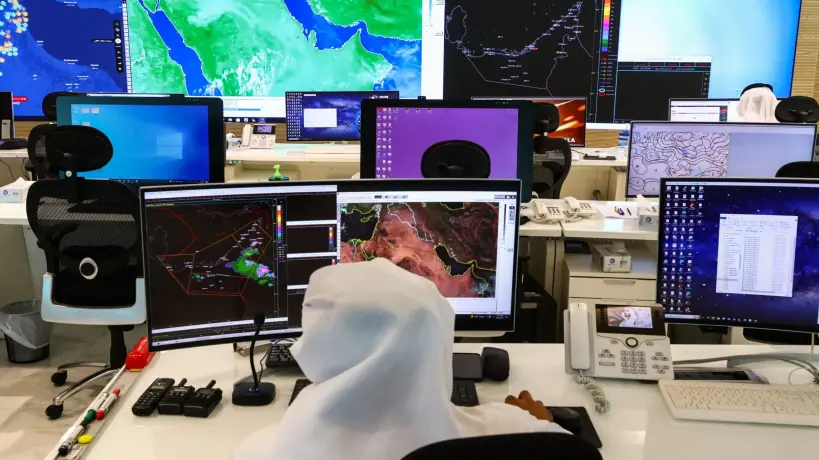
While the streets of Abu Dhabi saw a coordinated community response to the recent downpour, a silent, sophisticated operation was unfolding in the cloud.
Alongside the evident efforts of emergency response teams, the emirate’s advanced smart city infrastructure has become the first line of defense, utilizing real-time data and artificial intelligence to prevent recent weather events from escalating into a full-blown crisis.
This seamless integration of technology and crisis management unequivocally underscores that infrastructure security in Abu Dhabi is a non-negotiable priority.
The ability to detect and respond to “unusual activities” is no longer limited to human monitoring but extends to digital systems that proactively protect the public.
Accordingly, the deployment of automated traffic management systems and flood prediction models, similar to the recently enhanced “Melfi” system in the healthcare sector that tracks any anomalies in records, undoubtedly ensures a higher level of public safety.
Furthermore, the use of digital records and centralized command centers helps mitigate the risks of human error or delayed response.
Just as employing unlicensed practitioners poses a serious risk to public health, the failure to utilize advanced predictive technologies during severe weather events could jeopardize the safety of the entire community.
Therefore, the proactive measures taken during this rain event reflect a broader vision: building a resilient society where all services are based on a strong, data-driven framework.
Thus, with global climate patterns becoming increasingly difficult to predict, Abu Dhabi is setting a global benchmark in weather resilience.
It should also be noted that this recent success is not simply about managing a few days of rain, but rather a tangible embodiment of the Abu Dhabi 2030 vision.
By integrating the Internet of Things with emergency services, the emirate is demonstrating that the city can be both a desert oasis and a technologically advanced fortress against the vagaries of the weather.
Read also: How does the Burj Khalifa survive lightning strikes?.







Comments
Log in to write a comment