


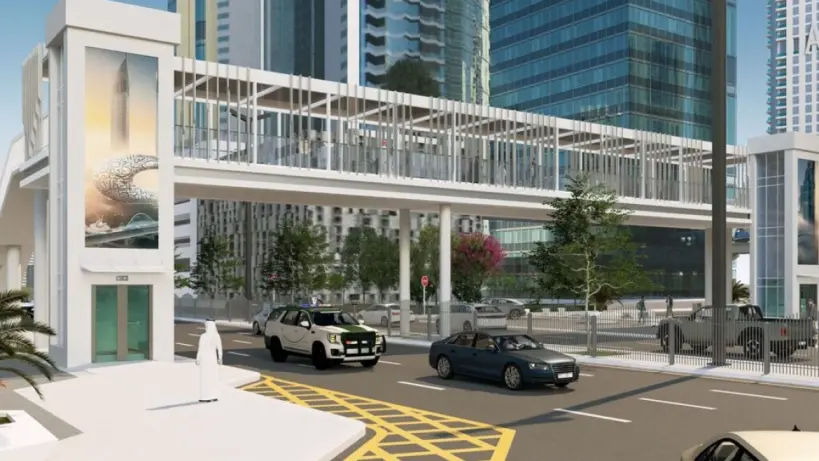
Dubai has launched a significant step in redefining its road and transport network, as Sheikh Hamdan bin Mohammed bin Rashid Al Maktoum inspected the progress of major infrastructure initiatives.
The latest projects are designed not only to enhance urban mobility but also to elevate the city’s architectural identity and dramatically reduce travel times on crucial routes.
The Crown Prince of Dubai, who also serves as Deputy Prime Minister, Minister of Defence, and Chairman of The Executive Council, approved an architectural identity framework. This initiative aims to enrich the visual character of Dubai’s roads, corridors, and streets in accordance with the city’s vision for integrated and sustainable urban development.
During his review, Sheikh Hamdan examined the AED1.3 billion ($354 million) Trade Centre Roundabout and Al Mustaqbal Street improvement projects. These works feature the construction of seven bridges and three tunnels extending across 6.5 kilometers.
Major Traffic Plan Announced
The new infrastructure will serve seven important residential and development zones-including Dubai World Trade Centre, Dubai International Financial Centre (DIFC), Emirates Towers, Museum of the Future, and Downtown Dubai. The upgrades are projected to benefit over one million residents and visitors by cutting average travel time by approximately 75 percent.
Additionally, Sheikh Hamdan reviewed plans for the Dubai Tunnels initiative. This project seeks to transform significant infrastructure into cultural landmarks by featuring murals created in collaboration with local artists.
Mattar Al Tayer, Director-General and Chairman of the Board of Executive Directors at Dubai’s Roads and Transport Authority (RTA), welcomed Sheikh Hamdan and briefed him on Dubai's expansive transport system-which encompasses more than 25,000 lane-kilometers serving upwards of 3.5 million vehicles each day.
Dubai continues to receive international acclaim for both the rapid pace and effectiveness of its transport infrastructure development efforts.
RTA’s Strategic Approach
The RTA constructs an average of 829 lane-kilometers per year-more than twice the global average-and achieves cost efficiencies ranging from one-and-a-half to two-and-a-half times those seen in large cities such as Moscow, Shenzhen or Milan.
The boost in road infrastructure has contributed directly to property value increases ranging from six percent up to sixteen percent. Between now and 2027, RTA is set to implement an additional seventy-two projects valued at roughly AED35 billion ($9.53 billion).
The vital Trade Centre Roundabout Improvement Project currently stands at forty percent completion. Once finished, it will link Sheikh Zayed Road with five key routes:
- Sheikh Khalifa bin Zayed Street
- Sheikh Rashid Street
- 2nd December Street
- Zabeel Palace Street
- Al Majlis Street
A phased opening starts in January next year with two bridges facilitating movement from 2nd December Street toward Al Majlis Street and Sheikh Rashid Street.
New Bridges and Tunnel Connections
A second bridge linking Sheikh Zayed Road with Sheikh Khalifa bin Zayed Street will follow in March; two further bridges providing access from Sheikh Rashid Street and Al Majlis Street towards 2nd December Street are planned for October 2026.
This overhaul entails constructing five bridges stretching five kilometers total while converting the existing roundabout into a surface-level intersection for improved traffic circulation in all directions.
Upon completion, this junction is expected to double its capacity-reducing average delays from twelve minutes down to ninety seconds-and shorten travel time between Sheikh Zayed Road and Sheikh Khalifa bin Zayed Street from six minutes to just one minute.
The Crown Prince also received updates on the Al Mustaqbal Street Improvement Project that spans from Zabeel Palace Street through Financial Centre Street.
This section includes new bridges and tunnels totaling fifteen hundred meters; it will widen the corridor from three lanes per direction up to four lanes each way by its scheduled completion in 2027.
The upgrade will increase capacity by thirty-three percent-from sixty-six hundred vehicles per hour up to eighty-eight hundred-while halving average travel times along this segment from thirteen minutes down to six minutes.
Enhanced Flow Across Main Corridors
This comprehensive project features three tunnels spanning a combined eleven hundred meters at Al Mustaqbal's intersection with Trade Centre Street a four-hundred-meter two-lane bridge serving World Trade Centre traffic as well as widening efforts covering thirty-five hundred kilometers overall.Additional improvements include free-flow connections at Exhibition Street and Trade Centre Street; a new pedestrian crossing on Sukuk Street plus modifications at several intersections along the route.
Architectural Identity & Urban Master Plan Alignment
The visit also featured a review of Dubai's updated architectural identity plan-aligned with objectives set out under the Dubai 2040 Urban Master Plan-to unify appearance standards for future infrastructure projects using innovative designs inspired by local heritage.
This policy covers everything from bridge facades to lighting fixtures and street furniture ensuring coherence throughout different urban spaces.
Diversifying urban design according to function across six classifications-residential, rural, general industrial, mixed-use, historic/artistic, and high-end attractions-the strategy specifies tailored materials, tones,and motifs to blend utility with distinctive aesthetics.
Global Design Competition: The Dubai Urban Challenge
Sheikh Hamdan was also presented results from the recent global competition-the “Dubai Urban Challenge”-which attracted more than five hundred creators hailing from ninety-one countries. Notable winners included Oliver Charles (UK) for "A Thread Through Time," Mohammed Ayash (Saudi Arabia) for "Breathing Masonry," as well as Giulietta Debrutti (Argentina) for "Echo."
Concluding his visit, sheikh Hamdan explored future phases of the ongoing Dubai Tunnels beautification campaign targeting eighteen sites via artistic lighting installations, high-performance wall panels, and eco-friendly materials-all reinforcing Dubai's commitment toward world-class urban design integrating functionality alongside cultural vibrance.

Comments
Log in to write a comment