


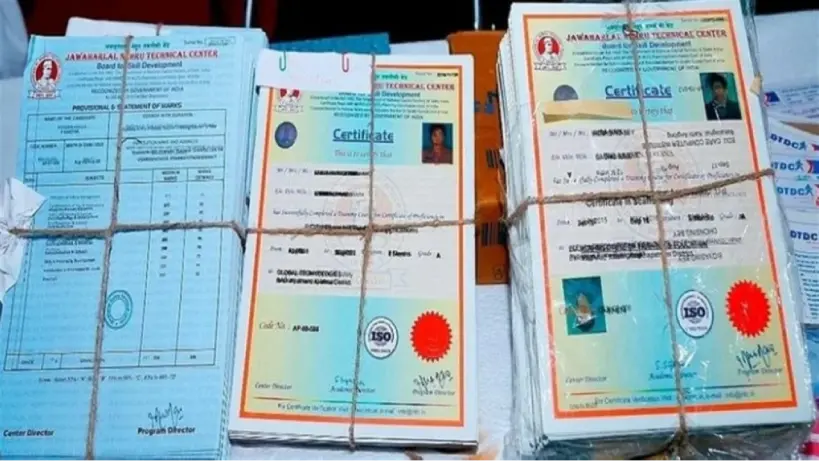
Unconfirmed talks are circulating within academic and professional circles suggesting that authorities in several Gulf countries may consider launching a wide-scale review of academic certificates issued by Southeast Asian countries, following the exposure of one of the largest academic forgery cases in India’s history.
Indian authorities in the southern state of Kerala have dismantled a vast criminal network involved in forging university degrees across the country.
Investigations revealed that the network produced nearly one million fake academic certificates, falsely attributed to Indian and foreign universities.
Police arrested 11 individuals linked to printing, forgery, and distribution operations. Raids led to the seizure of hundreds of printers, computers, and counterfeit seals, while authorities recovered approximately 100,000 forged certificates linked to 22 universities outside Kerala, all bearing realistic names, stamps, and fabricated signatures.
According to investigators, forged degrees were sold for prices ranging between $3,000 and $6,000, distributed through agents operating across multiple Indian states.
Authorities are also examining potential involvement of university officials and tracking recipients who may have used the certificates to secure jobs or benefits.
The alleged mastermind, Danish Dharman, known as “Danny,” had previously faced investigation in 2013 for similar offenses. After his release, he reportedly restarted operations from a rented house in Tamil Nadu, employing experienced printing workers.
Profits were invested in real estate and businesses inside and outside India before his arrest while attempting to flee abroad with his family.
The scandal revealed forged qualifications in highly sensitive fields, including medicine, nursing, engineering, aviation, and fire safety, triggering widespread concern over public safety and professional credibility.
The case began by chance in Andhra Pradesh when police questioned the authenticity of a store manager’s certificate during a routine inspection, uncovering a forged document. This discovery led to a nationwide investigation into a network operating under the guise of a fake technical institute mimicking a real university’s name.
Authorities estimate the network issued around 500 different types of fake certificates, complete with counterfeit holograms and seals for 28 universities. Paper records show over 2,400 certificates, while official estimates suggest the total number exceeded one million, with some used for overseas employment.
Operations spanned 11 Indian states, involving secret printing facilities and 155 distribution channels. Seven key suspects now face fraud and forgery charges under Indian law, potentially carrying prison sentences of up to seven years.
Indian officials confirmed that investigations are ongoing to uncover any internal collusion within legitimate universities, amid growing fears that forged qualifications may have spread internationally raising serious questions about the safety and reliability of professionals working abroad.







Comments
Log in to write a comment